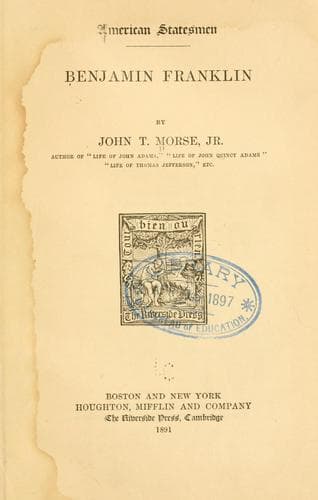
Benjamin FranklinMorse, John T., Jr. (John Torrey)
History
Benjamin Franklin
Morse, John T., Jr. (John Torrey)
Franklin, Benjamin, 1706-1790
A few weeks later he wrote: "I have some little property in America. I
will freely spend nineteen shillings in the pound to defend my right of
giving or refusing the other shilling. And, after all, if I cannot
defend that right, I can retire cheerfully with my family into the
boundless woods of America, which are sure to afford freedom and
subsistence to any man who can bait a hook or pull a trigger." The
picture of Dr. Franklin, the philosopher, at the age of sixty-one,
"cheerfully" sustaining his family in the wilderness by the winnings of
his rod and his rifle stirs one's sense of humor; but the paragraph
indicates that he was in strict harmony with his countrymen, who were
expressing serious resolution with some rhetorical exaggeration, in the
American fashion.
The main argument of the colonies, that under the British constitution
there could be no taxation without representation, was of course
introduced into the examination; and Franklin seized the occasion to
express his theory very ingeniously. Referring to the fact that, by the
Declaration of Rights, no money could "be raised on the subject but by
consent of Parliament," the subtle question was put: How the colonists
could think that they themselves had a right to levy money for the
crown? Franklin replied: "They understand that clause to relate only to
subjects within the realm; that no money can be levied on _them_ for the
crown but by consent of Parliament. The colonies are not supposed to be
within the realm; they have assemblies of their own, which are their
parliaments." This was a favorite theory with him, in expounding which
he likened the colonies to Ireland, and to Scotland before the union.
Many sentences to the same purport occur in his writings; for example:
"These writers against the colonies all bewilder themselves by supposing
the colonies _within_ the realm, which is not the case, nor ever was."
"If an Englishman goes into a foreign country, he is subject to the laws
and government he finds there. If he finds no government or laws there,
he is subject there to none, till he and his companions, if he has any,
make laws for themselves; and this was the case of the first settlers in
America. Otherwise, if they carried the English laws and power of
Parliament with them, what advantage could the Puritans propose to
themselves by going?" "The colonists carried no law with them; they
carried only a power of making laws, or adopting such parts of the
English law or of any other law as they should think suitable to their
circumstances."[21] Radical doctrines these, which he could not
reasonably expect would find favor under any principles of government
then known in the world. To the like effect were other assertions of
his, made somewhat later: "In fact, the British Empire is not a single
state; it comprehends many." "The sovereignty of the crown I understand.
The sovereignty of the British legislature out of Britain I do not
Public-domain text, read in full here on John Shaqi.
Reviews
Reviews
No reviews yet
Be the first to share your thoughts on this work.
Elsewhere in the archive
Join the Discussion
Join the discussion
Sign in to leave a comment or review.
Sign InorCreate an account