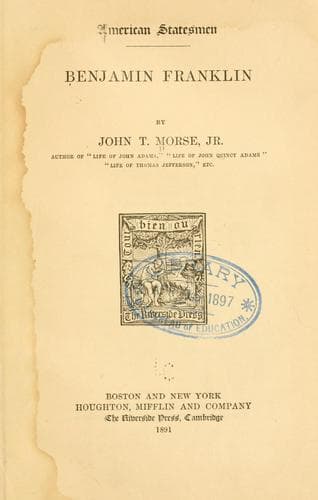
Benjamin FranklinMorse, John T., Jr. (John Torrey)
History
Benjamin Franklin
Morse, John T., Jr. (John Torrey)
Franklin, Benjamin, 1706-1790
Franklin's famous examination and his other efforts in behalf of the
colonies were appreciated by his countrymen outside of Pennsylvania. He
was soon appointed agent also for New Jersey, Georgia, and
Massachusetts. The last office was conferred upon him in the autumn of
1770, by no means without a struggle. Samuel Adams, a man as narrow as
Franklin was broad, as violent as Franklin was calm, as bigoted a
Puritan as Franklin was liberal a Free-thinker, felt towards Franklin
that distrust and dislike which a limited but intense mind often
cherishes towards an intellect whose vast scope and noble serenity it
cannot comprehend. Adams accordingly strenuously opposed the
appointment. It was plausibly suggested that Franklin already held other
agencies, and that policy would advise "to enlarge the number of our
friends." It was meanly added that he held an office under the crown,
and that his son was a royal governor. Other ingenious, insidious, and
personal objections were urged. Fortunately, however, it was in vain to
array such points against Franklin's reputation. Samuel Cooper wrote to
him that, though the House had certainly been much divided, "yet such
was their opinion of your abilities and integrity, that a majority
readily committed the affairs of the province at this critical season
to your care." By reason of this combination of agencies, besides his
own personal capacity and prestige, Franklin seemed to become in the
eyes of the English the representative of all America. In spite of the
unpopularity attaching to the American cause, the position was one of
some dignity, greatly enhanced by the respect inspired by the ability
with which Franklin filled it, ability which was recognized no less by
the enemies than by the friends of the provinces. It was also a position
of grave responsibility; and it ought to have been one of liberal
emolument, but it was not. The sum of his four salaries should have been
L1200; but only Pennsylvania and New Jersey actually paid him.
Massachusetts would have paid, but the bills making the appropriations
were obstinately vetoed by the royalist governor.[26]
[Note 26: Franklin's _Works_, iv. 88.]
Public-domain text, read in full here on John Shaqi.
Reviews
Reviews
No reviews yet
Be the first to share your thoughts on this work.
Elsewhere in the archive
Join the Discussion
Join the discussion
Sign in to leave a comment or review.
Sign InorCreate an account