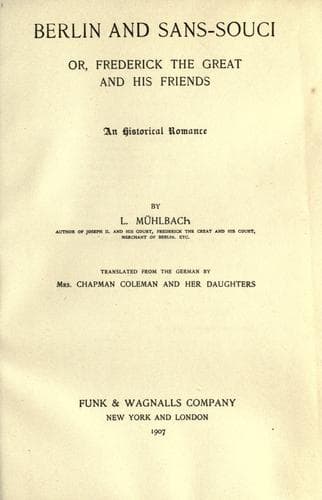
Berlin and Sans-Souci; Or, Frederick the Great and His Friends — John Shaqi
Berlin and Sans-Souci; Or, Frederick the Great and His FriendsMühlbach, L. (Luise)
History
Berlin and Sans-Souci; Or, Frederick the Great and His Friends
Mühlbach, L. (Luise)
Frederick II, King of Prussia, 1712-1786 -- Fiction; Prussia (Germany) -- History -- Frederick II, 1740-1786 -- Fiction
Barbarina was indeed lovely, irresistibly lovely, in her ravishing
costume of a shepherdess; her dress was of crimson satin, her black
velvet bodice was fastened over her voluptuous bosom by rich golden
cords, finished off by tassels glittering with diamonds. A wreath of
crimson roses adorned her hair, which fell in graceful ringlets
about her wondrous brow, and formed a rich frame around her pure,
oval face. The dark incarnate of her full, ripe lip contrasted
richly with the light, rosy blush of her fair, smooth cheek.
Barbarina's smile was a promise of love and bliss; and, when those
great fiery eyes looked at you earnestly, there was such an intense
glow, such a depth of power and passion in their rays, you could not
but feel that there was danger in her love as in her scorn.
To-day, she would neither threaten nor inspire; she was only a
smiling, joyous, simple peasant-girl, who had returned wild with joy
to her native village, and whose rapture found expression in the gay
and graceful mazes of the dance. She floated here and there, like a
wood-nymph, smiling, happy, careless, wonderful to look upon in her
loveliness and beauty, but more wonderful still in her art.
Simplicity and grace marked every movement; there seemed no
difficulties in her path--to dance was her happiness.
The dance was at an end. Barbarina, breathless, glowing, smiling,
bowed low. Then all was still; no hand was moved, no applause
greeted her. Her great burning eyes wandered threateningly and
questioningly over the saloon; then, raising her lovely head
proudly, she stepped back.
The curtain fell, and now all eyes were fixed upon the king, in
whose face the courtiers expected to read the impression which the
signora had made upon him; but the countenance of the king told
nothing; he was quiet and thoughtful, his brow was stern, and his
lips compressed. The courtiers concluded that he was disappointed,
and began at once to find fault, and make disparaging remarks.
Frederick did not regard them. At this moment he was not a king, he
was only a man--a man who, in silent rapture, had gazed upon this
wondrous combination of grace and beauty. The king was a hero, but
he trembled before this woman, and a sort of terror laid hold upon
him.
The curtain rose, and the second act of the drama began; no one
looked at the stage; after this living, breathing, impersonation of
a simple story, a spoken drama seemed oppressive. Every one rejoiced
when the second act was at an end. The curtain would soon rise for
Barbarina.
But this did not occur; there was a long delay; there was eager
expectation; the curtain did not rise; the bell did not ring. At
last, Baron Swartz crossed the stage and drew near to the king.
"Sire," said he, "the Signora Barbarina declares she will not dance
again; she is exhausted by grief and anxiety, and fatigued by her
journey."
Public-domain text, read in full here on John Shaqi.
Reviews
Reviews
No reviews yet
Be the first to share your thoughts on this work.
Join the Discussion
Join the discussion
Sign in to leave a comment or review.
Sign InorCreate an account