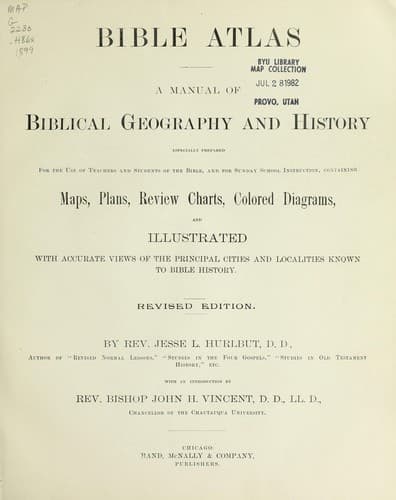
Bible Atlas: A Manual of Biblical Geography and HistoryHurlbut, Jesse Lyman
Religion
Bible Atlas: A Manual of Biblical Geography and History
Hurlbut, Jesse Lyman
Bible -- Geography; Bible -- Geography -- Maps; Bible -- History of Biblical events
5. =Pursuit of the Elamites.= (Gen. 14.) At that period the early
Babylonian empire, under Amraphel or Hammurabi (see p. 91), was at the
height of its power. Its king governed Elam, Chaldea, Assyria,
Mesopotamia, and most of Palestine. Chedorlaomer, the head of the united
peoples, led his armies against the aboriginal races east of the Jordan.
(See Map of Palestine Before the Conquest, and description, on page 37.)
After subduing them he passed around south of the Dead Sea, smote the
Amorites in the mountains near Hazezon-tamar, afterward En-gedi, and
poured his host down upon the Jordan Valley. The cities on the north of
the Dead Sea, Sodom and Gomorrah, with their dependent villages, being
unable to stay his progress, were ravaged, and their inhabitants
(including Abraham's nephew Lot) carried away captive, up the valley.
News of the invasion came to Abraham, and he instantly gathered his
servants and allies, and pursued the marauders. He overtook them near
Laish, afterward Dan, now _Tell el Kady_, attacked them by night,
pursued them as far as Hobah, near Damascus, and brought back the booty
and the prisoners. On the return took place the remarkable interview
with Melchizedek, a priest-king over the city of Salem, perhaps the
place afterward Jerusalem. After the return to Hebron the following
events occurred: 1. The covenant of God with Abraham. (Gen. 15.) 2. The
birth of Ishmael. (Gen. 16.) 3. The destruction of Sodom and Gomorrah.
(Gen. 18, 19.) These cities were probably located on the plain of
Jordan, north of the Dead Sea, and not on the south, as formerly
supposed; but all traces of them have entirely disappeared.
[Illustration: EMPIRE OF AMRAPHEL OR HAMMURABI.]
6. =The Settlement at Beersheba.= (Gen. 20-25.) After the destruction of
the cities of the plain, Abraham moved southward, and made his home at
Beersheba, on the desert border, now _Bir es Seba_. Here he spent most
of his later years, as after various journeys we find him each time
encamped at Beersheba.
7. =The Offering of Isaac.= (Gen. 22.) From Beersheba Abraham took his
son Isaac, at God's command, to offer him as a burnt offering in "the
land of Moriah." Some authorities accept the Samaritan tradition, that
this place was Mount Gerizim; but we see no sufficient reason to dissent
from the general view, that it was Mount Moriah, at Jerusalem, ten
centuries afterward the site of the Temple. After this sublime token of
his faith in God, the patriarch returned to his tent at Beersheba.
Public-domain text, read in full here on John Shaqi.
Reviews
Reviews
No reviews yet
Be the first to share your thoughts on this work.
Elsewhere in the archive
Join the Discussion
Join the discussion
Sign in to leave a comment or review.
Sign InorCreate an account