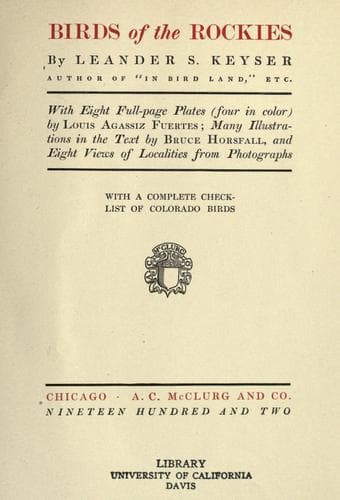
Birds of the RockiesKeyser, Leander S. (Leander Sylvester)
History
Birds of the Rockies
Keyser, Leander S. (Leander Sylvester)
Birds; Birds -- Colorado
Turtle doves were also plentiful in the valley above Malta, as they were
in most suitable localities. Here were also several western robins, one
of which saluted me with a cheerful carol, whose tone and syllabling
were exactly like those of the merry redbreast of our Eastern States. I
was delighted to find the sweet-voiced white-crowned sparrows tenants of
this valley, although they were not so abundant here as they had been a
little over a week before in the hollows below the summit of Pike's
Peak. But what was the bird which was singing so blithely a short
distance up the slope? He remained hidden until I drew near, when he
ran off on the ground like a frightened doe, and was soon ensconced in a
sage bush. Note his chestnut crest and greenish back. This is the
green-tailed towhee. He is one of the finest vocalists of the Rocky
Mountains, his tones being strong and well modulated, his execution
almost perfect as to technique, and his entire song characterized by a
quality that might be defined as human expressiveness.
A pair of western chipping sparrows were feeding their young in one of
the sage bushes. I hoped to find a nest, but my quest simply proved that
the bantlings had already left their nurseries. It was some
satisfaction, however, to establish the fact at first hand that the
western chipping sparrows breed at an elevation of nine thousand five
hundred and eighty feet above sea-level.
While strolling about a short distance above the town, I discovered an
underground passage leading to some of the factories, or perhaps the
smelting works, a few miles farther up the valley. The over-arching
ground and timbers forming the roof were broken through at various
places, making convenient openings for the unwary pedestrian to tumble
through should he venture to stroll about here by night. Suddenly a
little broad-shouldered bird appeared from some mysterious quarter, and
flitted silently about from bush to bush or from one tussock of grass to
another. To my surprise, he presently dropped into one of the openings
of the subterranean passage, disappeared for a few moments, and then
emerged from another opening a little farther away. The bird--let me say
at once--was Say's phoebe, with which, as previously told, I made
acquaintance at Glenwood. He may be recognized by the reddish or
cinnamon-brown cast of his abdomen and sides. Again and again he darted
into the passage, perhaps to make sure that his bairns had not been
kidnapped, and then came up to keep a vigilant eye on his visitor, whom
he was not wholly disposed to trust. I am not sure that there was a nest
in the subterranean passage, as my time was too short to look for it.
Others may not regard it as an important ornithological discovery, and I
do not pretend that it was epoch-making, but to me it was at least
interesting to find this species, which was new to me, dwelling at an
elevation of five thousand seven hundred and fifty-eight feet on the
Public-domain text, read in full here on John Shaqi.
Reviews
Reviews
No reviews yet
Be the first to share your thoughts on this work.
Join the Discussion
Join the discussion
Sign in to leave a comment or review.
Sign InorCreate an account