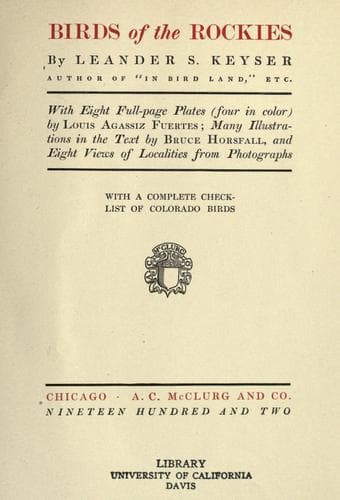
Birds of the RockiesKeyser, Leander S. (Leander Sylvester)
History
Birds of the Rockies
Keyser, Leander S. (Leander Sylvester)
Birds; Birds -- Colorado
The process of feeding the juvenile birds was interesting. The parents
would swim about, then suddenly dip their heads into the water, or else
dive clear under, coming up with slugs in their bills. Turning to the
youngsters, which were always close upon their heels--or perhaps I
would better say their tails--they would hold out their bills, when the
little ones would swim up and pick off the toothsome morsel. It must not
be supposed that the bantlings opened their mouths, as most young birds
do, to receive the tidbits. No, indeed! That is not coot vogue. The
little ones picked the insects from the sides of the papa's or mamma's
beak, turning their own little heads cunningly to one side as they
helped themselves to their luncheon.
The other waterfowl of the lake acted in an ordinary way, and therefore
need no description. It was strange, however, that this was the only
lake seen in all my Rocky Mountain touring where I found waterfowl. At
Seven Lakes, Moraine Lake, and others in the vicinity of Pike's Peak,
not a duck, crane, or coot was to be seen; and the same was true of
Cottonwood Lake, twelve miles from Buena Vista, right in the heart of
the rugged mountains.
[Illustration: "_From their place among the reeds_"]
Two facts may account for the abundance of birds at the little lake near
Buena Vista; first, here they were protected from gunners and pot
hunters by the owner, whose residence commanded a full view of the whole
area; and, second, large spaces of the upper end of the lake was thickly
grown with flags and rushes, which were cut off from the shore by a
watery space of considerable breadth. In this place these birds found
coverts from enemies and suitable sites for their nests.
A BIRD MISCELLANY
It shall be my purpose in this chapter to describe with more or less
fulness a number of Rocky Mountain birds which have either not been
mentioned in previous chapters or have received only casual attention.
On reaching Colorado one is surprised to find none of our common blue
jays which are so abundant in the Eastern and Middle States. In my
numerous Rocky Mountain jaunts not one was seen. Yet this region does
not need to go begging for jays, only they belong to different groups of
the _Garrulinæ_ subfamily. The most abundant and conspicuous of these
western forms are the long-crested jays, so called on account of the
long tuft of black feathers adorning the occiput. This distinguishing
mark is not like the firm pyramidal crest of the eastern jay, but is
longer and narrower, and so flexible that it sways back and forth as the
bird flits from branch to branch or takes a hop-skip-and-jump over the
ground. Its owner can raise and lower it at will.
Public-domain text, read in full here on John Shaqi.
Reviews
Reviews
No reviews yet
Be the first to share your thoughts on this work.
Elsewhere in the archive
Join the Discussion
Join the discussion
Sign in to leave a comment or review.
Sign InorCreate an account