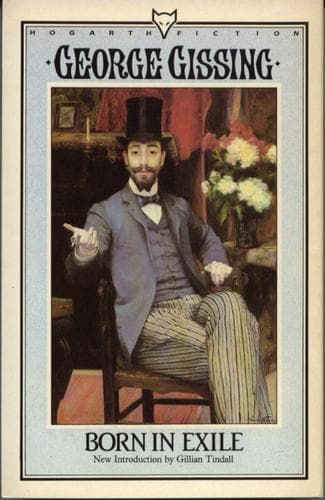
England -- Social life and customs -- 19th century -- Fiction; English fiction -- 19th century
'You would be so alone in London, Godwin.'
'Not a bit of it. Young Mr. Moxey will be a useful friend, I am
convinced he will. To tell you the whole truth, I aim at getting a
place at the works in Rotherhithe, where he no doubt has influence. You
see, mother, I might manage it even before the end of the year. Our Mr.
Moxey will be disposed to help me with his recommendation.'
'But, my dear, wouldn't it come to the same thing, then, if you went
back to Mr. Moxey's?'
He made a gesture of impatience.
'No, no, no! I couldn't live at Twybridge. I have my way to make,
mother, and the place for that is London. You know I am ambitious.
Trust me for a year or two, and see the result. I depend upon your help
in this whole affair. Don't refuse it me. I have done with Whitelaw,
and I have done with Twybridge: now comes London. You can't regard me
as a boy, you know.'
'No--but'--
'But me no buts!' he cried, laughing excitedly. 'The thing is settled.
As soon as possible in the morning I post this letter. I feel it will
be successful. See aunt to-morrow, and get her support. Mind that
Charlotte and Oliver don't talk to people. If you all use discretion,
there's no need for any curiosity to be excited.'
When Godwin had taken a resolve, there was no domestic influence strong
enough to prevent his acting upon it. Mrs. Peak's ignorance of the
world, her mild passivity, and the faith she had in her son's
intellectual resources, made her useless as a counsellor, and from no
one else--now that Mr. Gunnery was dead--would the young man have
dreamt of seeking guidance. Whatever Lady Whitelaw's reply, he had made
up his mind to go to London. Should his subsidy be refused, then he
would live on what his mother could allow him until--probably with the
aid of Christian Moxey--he might obtain a salaried position. The letter
was despatched, and with feverish impatience he awaited a reply.
Nine days passed, and he heard nothing. Half that delay sufficed to
bring out all the self-tormenting capacities of a nature such as his.
To his mother's conjectural explanations he could lend no ear.
Doubtless Lady Whitelaw (against whom, for subtle reasons, he was
already prejudiced) had taken offence; either she would not reply at
all, or presently there would come a few lines of polite displeasure,
intimating her disinclination to aid his project. He silently raged
against 'the woman'. Her neglect was insolence. Had she not delicacy
enough to divine the anxiety natural to one in his dependent position?
Did she take him for an every-day writer of mendicant appeals? His
pride fed upon the outrage and became fierce.
Public-domain text, read in full here on John Shaqi.
Reviews
Reviews
No reviews yet
Be the first to share your thoughts on this work.
Join the Discussion
Join the discussion
Sign in to leave a comment or review.
Sign InorCreate an account