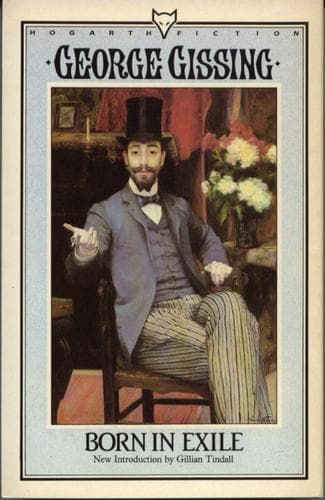
England -- Social life and customs -- 19th century -- Fiction; English fiction -- 19th century
In the spring of 1882 Mr. Jarvis Runcorn, editor and co-proprietor of
the London _Weekly Post_, was looking about for a young man of
journalistic promise whom he might associate with himself in the
conduct of that long established Radical paper. The tale of his years
warned him that he could not hope to support much longer a burden which
necessarily increased with the growing range and complexity of public
affairs. Hitherto he had been the autocrat of the office, but competing
Sunday papers exacted an alertness, a versatile vigour, such as only
youth can supply; for there was felt to be a danger that the _Weekly
Post_ might lose its prestige in democratic journalism. Thus on the
watch, Mr. Runcorn--a wary man of business, who had gone through many
trades before he reached that of weekly literature--took counsel one
day with a fellow-campaigner, Malkin by name, who owned two or three
country newspapers, and had reaped from them a considerable fortune; in
consequence, his attention was directed to one John Earwaker, then
editing the _Wattleborough Courier_. Mr. Malkin's eldest son had
recently stood as Liberal candidate for Wattleborough, and though
defeated was loud in his praise of the _Courier_; with its editor he
had come to be on terms of intimate friendship. Earwaker was well
acquainted with journalistic life in the provinces. He sprang from a
humble family living at Kingsmill, had studied at Whitelaw College, and
was now but nine-and-twenty: the style of his 'leaders' seemed to mark
him for a wider sphere of work. It was decided to invite him to London,
and the young man readily accepted Mr. Runcorn's proposals. A few
months later he exchanged temporary lodgings for chambers in Staple
Inn, where he surrounded himself with plain furniture and many books.
In personal appearance he had changed a good deal since that prize-day
at Whitelaw when his success as versifier and essayist foretold a
literary career. His figure was no longer ungainly; the big head seemed
to fit better upon the narrow shoulders. He neither walked with
extravagant paces, nor waved his arms like a windmill. A sufficiency of
good food, and the habit of intercourse with active men; had given him
an every-day aspect; perhaps the sole peculiarity he retained from
student times was his hollow chuckle of mirth, a laugh which struggled
vainly for enlargement. He dressed with conventional decency, even
submitting to the chimney-pot hat. His features betrayed connection
with a physically coarse stock; but to converse with him was to
discover the man of original vigour and wide intellectual scope. With
ordinary companions, it was a rare thing for him to speak of his
professional interests. But for his position on _The Weekly Post_ it
would not have been easy to surmise how he stood with regard to
politics, and he appeared to lean as often towards the conservative as
to the revolutionary view of abstract questions.
Public-domain text, read in full here on John Shaqi.
Reviews
Reviews
No reviews yet
Be the first to share your thoughts on this work.
Elsewhere in the archive
Join the Discussion
Join the discussion
Sign in to leave a comment or review.
Sign InorCreate an account