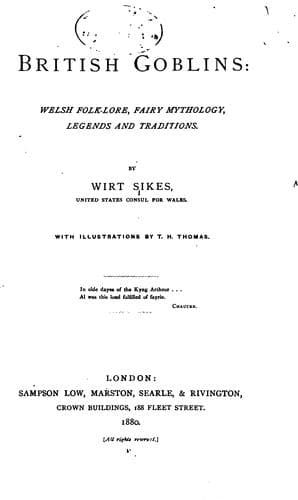
British Goblins: Welsh Folk-lore, Fairy Mythology, Legends and TraditionsSikes, Wirt
History
British Goblins: Welsh Folk-lore, Fairy Mythology, Legends and Traditions
Sikes, Wirt
Folklore -- Wales; Goblins -- Wales; Mythology, Celtic -- Wales; Mythology, Welsh; Wales -- Social life and customs
The Tylwyth Teg have a fatal admiration for lovely children. Hence the
abundant folk-lore concerning infants who have been stolen from their
cradles, and a plentyn-newid (change-child--the equivalent of our
changeling) left in its place by the Tylwyth Teg. The plentyn-newid
has the exact appearance of the stolen infant, at first; but its
aspect speedily alters. It grows ugly of face, shrivelled of form,
ill-tempered, wailing, and generally frightful. It bites and strikes,
and becomes a terror to the poor mother. Sometimes it is idiotic; but
again it has a supernatural cunning, not only impossible in a mortal
babe, but not even appertaining to the oldest heads, on other than
fairy shoulders. The veracious Prophet Jones testifies to a case where
he himself saw the plentyn-newid--an idiot left in the stead of a son
of Edmund John William, of the Church Valley, Monmouthshire. Says
Jones: 'I saw him myself. There was something diabolical in his
aspect,' but especially in his motions. He 'made very disagreeable
screaming sounds,' which used to frighten strangers greatly, but
otherwise he was harmless. He was of a 'dark, tawny complexion.' He
lived longer than such children usually lived in Wales in that day, (a
not altogether pleasant intimation regarding the hard lot to which
such children were subjected by their unwilling parents,) reaching the
age of ten or twelve years. But the creed of ignorance everywhere as
regards changelings is a very cruel one, and reminds us of the tests
of the witchcraft trials. Under the pretence of proving whether the
objectionable baby is a changeling or not, it is held on a shovel over
the fire, or it is bathed in a solution of the fox-glove, which kills
it; a case where this test was applied is said to have actually
occurred in Carnarvonshire in 1857. That there is nothing specially
Welsh in this, needs not to be pointed out. Apart from the fact that
infanticide, like murder, is of no country, similar practices as to
changelings have prevailed in most European lands, either to test the
child's uncanny quality, or, that being admitted, to drive it away and
thus compel the fairies to restore the missing infant. In Denmark the
mother heats the oven, and places the changeling on the peel,
pretending to put it in; or whips it severely with a rod; or throws it
into the water. In Sweden they employ similar methods. In Ireland the
hot shovel is used. With regard to a changeling which Martin Luther
tells of in his 'Colloquia Mensalia,' the great reformer declared to
the Prince of Anhalt, that if he were prince of that country he would
'venture _homicidium_ thereon, and would throw it into the River
Moldaw.' He admonished the people to pray devoutly to God to take away
the devil, which 'was done accordingly; and the second year after the
changeling died.' It is hardly probable that the child was very well
fed during the two years that this pious process was going on. Its
Public-domain text, read in full here on John Shaqi.
Reviews
Reviews
No reviews yet
Be the first to share your thoughts on this work.
Elsewhere in the archive
Join the Discussion
Join the discussion
Sign in to leave a comment or review.
Sign InorCreate an account