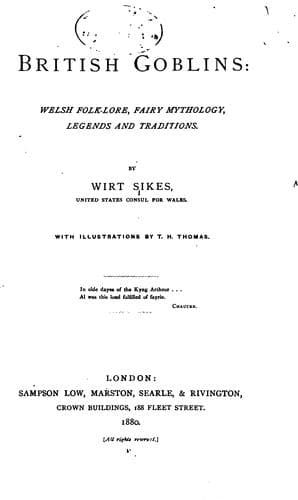
British Goblins: Welsh Folk-lore, Fairy Mythology, Legends and TraditionsSikes, Wirt
History
British Goblins: Welsh Folk-lore, Fairy Mythology, Legends and Traditions
Sikes, Wirt
Folklore -- Wales; Goblins -- Wales; Mythology, Celtic -- Wales; Mythology, Welsh; Wales -- Social life and customs
sometimes by the way he had gone, sometimes by others; at first in
company, and afterwards alone; and made himself known only to his
mother, to whom he described what he had seen. Being desired by her to
bring her a present of gold, with which that country abounded, he
stole, whilst at play with the king's son, a golden ball with which he
used to divert himself, and brought it in haste to his mother, but not
unpursued; for, as he entered the house of his father, he stumbled at
the threshold;' the ball fell, 'and two pigmies seizing it, departed,
showing the boy every mark of contempt and derision. Notwithstanding
every attempt for the space of a year, he never again could find the
track to the subterraneous passage.' He had made himself acquainted
with the language of his late hosts, 'which was very conformable to
the Greek idiom. When they asked for water, they said _Udor udorum_;
when they want salt, they say _Halgein udorum_.'[39]
FOOTNOTE:
[39] See Sir R. C. Hoare's Translation of Giraldus.
II.
Exactly similar to this medieval legend in spirit, although differing
widely in detail, is the modern story of Shuï Rhys, told to me by a
peasant in Cardiganshire. Shuï was a beautiful girl of seventeen, tall
and fair, with a skin like ivory, hair black and curling, and eyes of
dark velvet. She was but a poor farmer's daughter, notwithstanding her
beauty, and among her duties was that of driving up the cows for the
milking. Over this work she used to loiter sadly, to pick flowers by
the way, or chase the butterflies, or amuse herself in any agreeable
manner that fortune offered. For her loitering she was often chided;
indeed, people said Shuï's mother was far too sharp with the girl, and
that it was for no good the mother had so bitter a tongue. After all
the girl meant no harm, they said. But when one night Shuï never came
home till bed-time, leaving the cows to care for themselves, dame Rhys
took the girl to task as she never had done before. 'Ysgwaetheroedd,
mami,' said Shuï, 'I couldn't help it; it was the Tylwyth Teg.' The
dame was aghast at this, but she could not answer it--for well she
knew the Tylwyth Teg were often seen in the woods of Cardigan. Shuï
was at first shy about talking of the fairies, but finally confessed
they were little men in green coats, who danced around her and made
music on their tiny harps; and they talked to her in language too
beautiful to be repeated; indeed she couldn't understand the words,
though she knew well enough what the fairies meant. Many a time after
that Shuï was late; but now nobody chided her, for fear of offending
the fairies. At last one night Shuï did not come home at all. In alarm
the woods were searched; there was no sign of her; and never was she
seen in Cardigan again. Her mother watched in the fields on the
Teir-nos Ysprydion, or three nights of the year when goblins are sure
to be abroad; but Shuï never returned. Once indeed there came back to
Public-domain text, read in full here on John Shaqi.
Reviews
Reviews
No reviews yet
Be the first to share your thoughts on this work.
Elsewhere in the archive
Join the Discussion
Join the discussion
Sign in to leave a comment or review.
Sign InorCreate an account