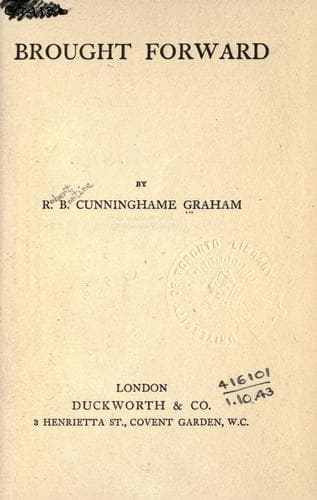
Brought ForwardCunninghame Graham, R. B. (Robert Bontine)
History
Brought Forward
Cunninghame Graham, R. B. (Robert Bontine)
Fiction; Short stories
The vegetable sellers had now removed from the middle of the square,
taking all their wares under the long verandah, and several pedlars had
set up their booths and retailed cheap European trifles such as no one in
the world but a Paraguayan Indian could possibly require. Razors that
would not cut, and little looking-glasses in pewter frames made in
Thuringia, cheap clocks that human ingenuity was powerless to repair when
they had run their course of six months’ intermittent ticking, and gaudy
pictures representing saints who had ascended to the empyrean, as it
appeared, with the clothes that they had worn in life, and all
bald-headed, as befits a saint, were set out side by side with
handkerchiefs of the best China silk. Sales were concluded after
long-continued chaffering—that higgling of the market dear to old-time
economists, for no one would have bought the smallest article, even below
cost price, had it been offered to him at the price the seller originally
asked.
Enrique Clerici, from Itapua, had transported all his pulperia bodily for
the occasion of the feast. It had not wanted more than a small wagon to
contain his stock-in-trade. Two or three dozen bottles of square-faced
gin of the Anchor brand, a dozen of heady red wine from Catalonia, a pile
of sardine boxes, sweet biscuits, raisins from Malaga, esparto baskets
full of figs, and sundry pecks of apricots dried in the sun and cut into
the shape of ears, and hence called “orejones,” completed all his store.
He himself, tall and sunburnt, stood dressed in riding-boots and a broad
hat, with his revolver in his belt, beside a pile of empty bottles, which
he had always ready, to hurl at customers if there should be any attempt
either at cheating or to rush his wares. He spoke the curious lingo,
half-Spanish, half-Italian, that so many of his countrymen use in the
River Plate; and all his conversation ran upon Garibaldi, with whom he
had campaigned in youth, upon Italia Irredenta, and on the time when
anarchy should sanctify mankind by blood, as he said, and bring about the
reign of universal brotherhood.
He did a roaring trade, despite the competition of a native Paraguayan,
who had brought three demi-johns of Caña, for men prefer the imported
article the whole world over, though it is vile, to native manufactures,
even when cheap and good.
Just about twelve o’clock, when the sun almost burned a hole into one’s
head, the band got ready in the church porch, playing upon old
instruments, some of which may have survived from Jesuit times, or, at
the least, been copied in the place, as the originals decayed.
Public-domain text, read in full here on John Shaqi.
Reviews
Reviews
No reviews yet
Be the first to share your thoughts on this work.
Join the Discussion
Join the discussion
Sign in to leave a comment or review.
Sign InorCreate an account