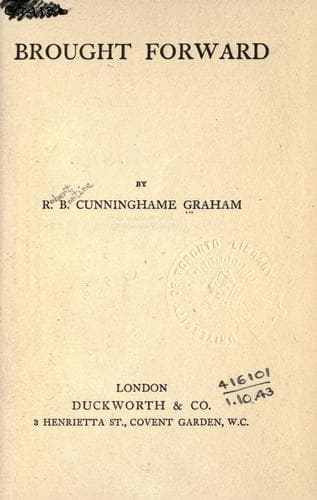
Brought ForwardCunninghame Graham, R. B. (Robert Bontine)
History
Brought Forward
Cunninghame Graham, R. B. (Robert Bontine)
Fiction; Short stories
As he approached the arch, in which the ring dangled from a string, his
horse, either frightened by the shouting of the crowd or by the arch
itself, swerved and plunged violently, carrying its rider through the
thickest of the people, who separated like a flock of sheep when a dog
runs through it, cursing him volubly. The German came the next, dressed
in his Sunday clothes, a slop-made suit of shoddy cloth, riding a horse
that all his spurring could not get into full speed. The rider’s round,
fair face was burned a brick-dust colour, and as he spurred and plied his
whip, made out of solid tapir hide, the sweat ran down in streams upon
his coat. So intent was he on flogging, that as he neared the ring he
dropped his piece of cane, and his horse, stopping suddenly just
underneath the arch, would have unseated him had he not clasped it round
the neck. Shouts of delight greeted this feat of horsemanship, and one
tall Correntino, taking his cigarette out of his mouth, said to his
fellow sitting next to him upon his horse, “The very animals themselves
despise the gringos. See how that little white-nosed brute that he was
riding knew that he was a ‘maturango,’ and nearly had him off.”
Next came Hijinio Rojas, a Paraguayan of the better classes, sallow and
Indian looking, dressed in clothes bought in Asuncion, his trousers
tucked into his riding-boots. His small black hat, with the brim
flattened up against his head by the wind caused by the fury of the
gallop of his active little roan with four white feet, was kept upon his
head by a black ribbon knotted underneath his chin. As he neared the
arch his horse stepped double several times and fly jumped; but that did
not disturb him in the least, and, aiming well he touched the ring,
making it fly into the air. A shout went up, partly in Spanish, partly
in Guarani, from the assembled people, and Rojas, reining in his horse,
stopped him in a few bounds, so sharply, that his unshod feet cut up the
turf of the green plaza as a skate cuts the ice. He turned and trotted
gently to the arch, and then, putting his horse to its top speed, stopped
it again beside the other riders, amid the “Vivas” of the crowd. Then
came the turn of the four Correntinos, who rode good horses from their
native province, had silver horse-gear and huge silver spurs, that
dangled from their heels. They were all gauchos, born, as the saying
goes, “amongst the animals.” A dun with fiery eyes and a black stripe
right down his back, and with black markings on both hocks, a chestnut
skewbald, a “doradillo,” and a horse of that strange mealy bay with a
fern-coloured muzzle, that the gauchos call a “Pangaré,” carried them
just as if their will and that of those who rode them were identical.
Without a signal, visible at least to any but themselves, their horses
started at full speed, reaching occasionally at the bit, then dropping it
again and bridling so easy that one could ride them with a thread drawn
from a spider’s web.
Public-domain text, read in full here on John Shaqi.
Reviews
Reviews
No reviews yet
Be the first to share your thoughts on this work.
Join the Discussion
Join the discussion
Sign in to leave a comment or review.
Sign InorCreate an account