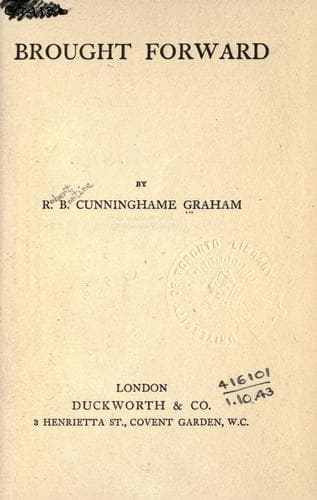
Brought ForwardCunninghame Graham, R. B. (Robert Bontine)
History
Brought Forward
Cunninghame Graham, R. B. (Robert Bontine)
Fiction; Short stories
A thick dust rose from the corral and hung above their heads. Sometimes
the horses stood all huddled up, gazing with wide distended eyes and
nostrils towards a group of men that lounged about the gate. At other
times that panic fear that seizes upon horses when they are crushed
together in large numbers, set them a-galloping. Through the dust-cloud
their footfalls sounded muffled, and they themselves appeared like
phantoms in a mist. When they had circled round a little they stopped,
and those outside the throng, craning their heads down nearly to the
ground, snorted, and then ran back, arching their necks and carrying
their tails like flags. Outside the great corral was set Parodi’s camp,
below some China trees, and formed of corrugated iron and hides, stuck on
short uprights, so that the hides and iron almost came down upon the
ground, in gipsy fashion. Upon the branches of the trees were hung
saddles, bridles, halters, hobbles, lazos, and boleadoras, and underneath
were spread out saddle-cloths to dry. Pieces of meat swung from the low
gables of the hut, and under the low eaves was placed a “catre,” the
canvas scissor-bedstead of Spain and of her colonies in the New World.
Upon the catre was a heap of ponchos, airing in the sun, their bright and
startling colours looking almost dingy in the fierce light of a March
afternoon in Uruguay. Close to the camp stood several bullock-carts,
their poles supported on a crutch, and their reed-covered tilts giving
them an air of huts on wheels. Men sat about on bullocks’ skulls, around
a smouldering fire, whilst the “maté” circulated round from man to man,
after the fashion of a loving-cup. Parodi, the stiff-jointed son of
Italian parents, a gaucho as to clothes and speech, but still
half-European in his lack of comprehension of the ways of a wild horse.
Arena, the capataz from Entre-Rios, thin, slight, and nervous, a man who
had, as he said, in his youth known how to read and even guide the pen;
but now “things of this world had turned him quite unlettered, and made
him more familiar with the lazo and the spurs.” The mulatto Pablo
Suarez, active and cat-like, a great race-rider and horse-tamer, short
and deep-chested, with eyes like those of a black cat, and toes,
prehensile as a monkey’s, that clutched the stirrup when a wild colt
began to buck, so that it could not touch its flanks. They and Miguel
Paralelo, tall, dark, and handsome, the owner of some property, but drawn
by the excitement of a cowboy’s life to work for wages, so that he could
enjoy the risk of venturing his neck each day on a “baguál,” {187} with
other peons as El Correntino and Venancio Baez, were grouped around the
fire. With them were seated Martin el Madrileño, a Spanish horse-coper,
who had experienced the charm of gaucho life, together with Silvestre
Ayres, a Brazilian, slight and olive-coloured, well-educated, but better
known as a dead pistol-shot than as man of books. They waited for their
Public-domain text, read in full here on John Shaqi.
Reviews
Reviews
No reviews yet
Be the first to share your thoughts on this work.
Elsewhere in the archive
Join the Discussion
Join the discussion
Sign in to leave a comment or review.
Sign InorCreate an account