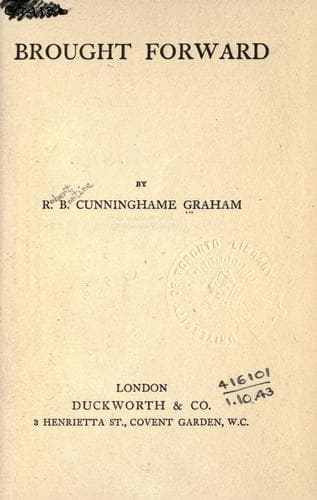
Brought ForwardCunninghame Graham, R. B. (Robert Bontine)
History
Brought Forward
Cunninghame Graham, R. B. (Robert Bontine)
Fiction; Short stories
Most of them, when they sold a horse, looked at him and remarked,
“Pobrecito, you will go to the Great War,” just as a man looks at his son
who is about to go, with feelings of mixed admiration and regret.
After we had examined all the Brazilian’s “Tropilla” so carefully that he
said, “By Satan’s death, your graces know far more about my horses than I
myself, and all I wonder is that you do not ask me if all of them have
not complied with all the duties of the Church,” we found that about
twenty of them were fit for the Great War. Calling upon Parodi and the
capataz of Bopicuá, who all the time had remained seated round the
smouldering fire and drinking maté, to prepare the branding-irons, the
peons led them off, our head man calling out “Artilleria” or
“Caballeria,” according to their size. After the branding, either on the
hip for cavalry and on the neck for the artillery, a peon cut their manes
off, making them as ugly as a mule, as their late owner said, and we were
once more ready for the road, after the payment had been made. This took
a little time, either because the Brazilian could not count, or perhaps
because of his great caution, for he would not take payment except horse
by horse. So, driving out the horses one by one, we placed a roll of
dollars in his hand as each one passed the gate. Even then each roll of
dollars had to be counted separately, for time is what men have the most
at their disposal in places such as Bopicuá.
Two hours of sunset still remained, with three long leagues to cover, for
in those latitudes there is no twilight, night succeeding day, just as
films follow one another in a cinematograph. At last it all was over,
and we were free to mount. Such sort of drives are of the nature of a
sport in South America, and so the Brazilian drove off the horses that we
had rejected, half a mile away, leaving them with a negro boy to herd,
remarking that the rejected were as good or better than those that we had
bought, and after cinching up his horse, prepared to ride with us.
Before we started, a young man rode up, dressed like an exaggerated
gaucho, in loose black trousers, poncho, and a “golilla” {194a} round his
neck, a lazo hanging from the saddle, a pair of boleadoras peeping
beneath his “cojinillo,” {194b} and a long silver knife stuck in his
belt. It seemed he was the son of an estanciero who was studying law in
Buenos Aires, but had returned for his vacation, and hearing of our drive
had come to ride with us and help us in our task. No one on such
occasions is to be despised, so, thanking him for his good intentions, to
which he answered that he was a “partizan of the Allies, lover of liberty
and truth, and was well on in all his studies, especially in
International Law,” we mounted, the gauchos floating almost
imperceptibly, without an effort, to their seats, the European with that
air of escalading a ship’s side that differentiates us from man less
civilised.
Public-domain text, read in full here on John Shaqi.
Reviews
Reviews
No reviews yet
Be the first to share your thoughts on this work.
Elsewhere in the archive
Join the Discussion
Join the discussion
Sign in to leave a comment or review.
Sign InorCreate an account