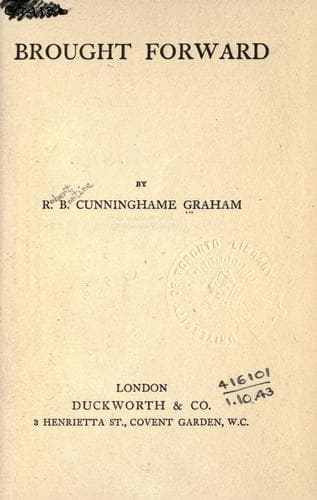
Brought ForwardCunninghame Graham, R. B. (Robert Bontine)
History
Brought Forward
Cunninghame Graham, R. B. (Robert Bontine)
Fiction; Short stories
A passing sleeve of locusts almost obscured the declining sun. Some flew
against our faces, reminding me of the fight Cortes had with the Indians
not far from Vera Cruz, which, Bernal Diaz says, was obstructed for a
moment by a flight of locusts that came so thickly that many lost their
lives by the neglect to raise their bucklers against what they thought
were locusts, and in reality were arrows that the Indians shot. The
effect was curious as the insects flew against the horses, some clinging
to their manes, and others making them bob up and down their heads, just
as a man does in a driving shower of hail. We reached a narrow causeway
that formed the passage through a marsh. On it the horses crowded,
making us hold our breath for fear that they would push each other off
into the mud, which had no bottom, upon either side. When we emerged and
cantered up a little hill, a lake lay at the bottom of it, and beyond it
was a wood, close to a railway siding. The evening now was closing in,
but there was still a good half-hour of light. As often happens in South
America just before sundown, the wind dropped to a dead calm, and passing
little clouds of locusts, feeling the night approach, dropped into the
long grass just as a flying-fish drops into the waves, with a harsh
whirring of their gauzy wings.
The horses smelt the water at the bottom of the hill, and the whole five
hundred broke into a gallop, manes flying, tails raised high, and we,
feeling somehow the gallop was the last, raced madly by their side until
within a hundred yards or so of the great lake. They rushed into the
water and all drank greedily, the setting sun falling upon their
many-coloured backs, and giving the whole herd the look of a vast tulip
field. We kept away so as to let them drink their fill, and then,
leading our horses to the margin of the lake, dismounted, and, taking out
their bits, let them drink, with the air of one accomplishing a rite, no
matter if they raised their heads a dozen times and then began again.
Slowly Arena, El Correntino, Paralelo, Suarez, and the rest drove out the
herd to pasture in the deep lush grass. The rest of us rode up some
rising ground towards the wood. There we drew up, and looking back
towards the plain on which the horses seemed to have dwindled to the size
of sheep in the half-light, some one, I think it was Arena, or perhaps
Pablo Suarez, spoke their elegy: “Eat well,” he said; “there is no grass
like that of La Pileta, to where you go across the sea. The grass in
Europe all must smell of blood.”
* * * * *
THE END
* * * * *
_Printed by_ R. & R. CLARK, LIMITED, _Edinburgh_.
NOTES.
{22} _Porteño_, literally a man born in the port of Buenos Aires, but is
also applied to any one born in the province of Buenos Aires.
Public-domain text, read in full here on John Shaqi.
Reviews
Reviews
No reviews yet
Be the first to share your thoughts on this work.
Elsewhere in the archive
Join the Discussion
Join the discussion
Sign in to leave a comment or review.
Sign InorCreate an account