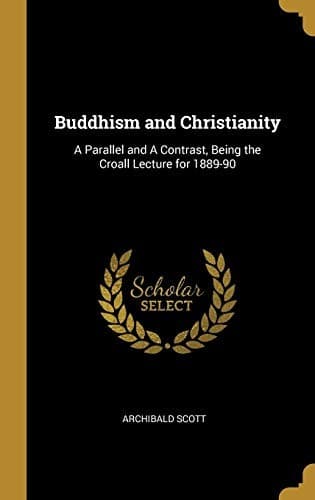
Buddhism and Christianity: A Parallel and a ContrastScott, Archibald
Religion
Buddhism and Christianity: A Parallel and a Contrast
Scott, Archibald
Buddhism -- Relations -- Christianity; Christianity and other religions -- Buddhism
Now Buddhism grew out of Brahmanism, but however divergent their
relations eventually became, it was originally accepted as a natural
consequence of it. Unlike Christianity and Judaism, there was for long
no trace of serious antagonism between the Brahmans and many generations
of the successors of Buddha. Brahmans formed a considerable portion of
his followers, and in regard to his teaching, his doctrines, where not
identical, were not likely to offend them. St. Paul scandalised the
Pharisees by preaching that outward Jewish connection marked by the seal
of circumcision profited nothing, but long before Buddha’s time Brahman
teachers had declared, as he did, to that most exclusive of the Indian
elect, that the true Brahman was not a person born within the sacred
caste, but only the thoughtful and self-controlled man:[84] that a bad
mind and wicked deeds are what defile a man, and that no outward
observances can purify him.[85] Buddha has been designated as the best
and wisest and greatest of Hindus; “a reformer of Hinduism who ignored
its superstitions and follies, and sought to elevate and refine its
dogmas.”[86] It is now considered very questionable whether the
difference between the two systems ever grew into hostility involving
persecution of the new religion by the old. The two streams of Hindu
belief seem for long in their course in India to have flowed peaceably
side by side, and if Buddhism eventually disappeared from India as a
separate and distinct system, it was not altogether because it was
crushed by persecution, but because it returned to enrich and modify the
religion from which it originally parted.[87]
Buddhism was thus an offspring of Brahmanism, but Brahmanism was itself
the product of a religion older still. Behind Buddhism lies a great and
undefined past, a past with no history in the proper sense of the word,
and absolutely without chronology; but out of this vast and nebulous era
there has been extracted a rich traditional literature, and Oriental
scholars working on principles similar to those by which geologic
periods are determined,[88] are endeavouring by an examination of the
various civilisations reflected in that literature to establish the
leading stages in the growth of prehistoric Indian thought. The sacred
books of India disclose sufficiently in outline the social and religious
progress of the people from a period of great antiquity. No one can tell
when the oldest fragments of them were originally composed, but some of
them are said to have been in circulation among the Aryans when one
immigrant contingent of them had arrived at the confluence of Jumna with
the Ganges,[89] and if so, they image for us the life and beliefs of a
people who must have been contemporaries with Moses some fifteen
centuries at latest before the coming of Christ.
Public-domain text, read in full here on John Shaqi.
Reviews
Reviews
No reviews yet
Be the first to share your thoughts on this work.
Join the Discussion
Join the discussion
Sign in to leave a comment or review.
Sign InorCreate an account