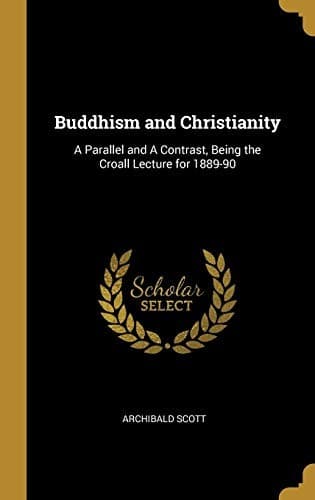
Buddhism and Christianity: A Parallel and a ContrastScott, Archibald
Religion
Buddhism and Christianity: A Parallel and a Contrast
Scott, Archibald
Buddhism -- Relations -- Christianity; Christianity and other religions -- Buddhism
Thus early in the history of the Indian people emerged that sacerdotal
institution which was to exercise so powerful and eventually so sinister
an influence upon their religious progress. In Vedic times the father of
the family and the rajah of the clan were the celebrants of the
religious rites, but as life became more complicated ceremonies became
more laborious, and men who had preserved the knowledge of the old
hymns, and the religious formularies which had died out from the common
people, gradually took the rajah’s place. As thought widened, men
refused to be satisfied with guardian deities that could be fed with
rice and butter. The sense of human law reflected itself in the
conception of divine rulers governing men, and penalties inflicted by
man for wrong-doing suggested expiation for the infringed laws of deity.
This idea of sacrifice, of which there is said to be no trace in the
flesh feasts of earlier times, becomes prominent in the offerings of the
period. “The shedding of blood, the burning of a limb of the victim in
the fire, by some at least was believed to atone for transgression, and
it is probable that at one time the religious instinct expressed itself
in human sacrifice.[95]” In any case, the development of the idea of the
great efficacy of sacrifice as a means of compelling the gods to do the
will of the worshipper—yea, of elevating the worshipper to their
privileges and rank,—must soon have had the effect of making a
priesthood, at first only helpful, to be necessary as the sole agents
between man and deity. By preserving the memory of what had faded from
the vulgar, by transmitting to their families a lore which became the
more sacred the more it was forgotten, the professional liturgists or
sacrificers, at first satirised by the poets as was the Romish friar by
the minstrel in the middle ages, imperceptibly grew into an order whose
privileges were more exclusive and whose pretensions were higher than
were ever asserted in Israel by the descendants of Aaron. Among the
Hebrews the priesthood was never allowed to gain complete ascendency.
Its representatives were subordinated to the king, who was the fountain
of all law, and they were kept in check by the prophets as the ministers
of Divine revelation; but the Brahmans came to be regarded as not only
the guardians of religion, but the teachers of all knowledge and the
source of all authority. They owned no superior, were subject to no law
in the state: each one was a pope in himself, more independent of the
crown and the commonwealth than a Christian pope ever pretended to be,
and had a faith in his personal infallibility which no Christian pope
affected to have. In India there resulted from the ascendency all the
evils that were manifested in Judaism and in Latin Christianity; and in
India far worse results were produced. For, left to themselves as
superior beings apart from the actual world, who never could err, they
Public-domain text, read in full here on John Shaqi.
Reviews
Reviews
No reviews yet
Be the first to share your thoughts on this work.
Elsewhere in the archive
Join the Discussion
Join the discussion
Sign in to leave a comment or review.
Sign InorCreate an account