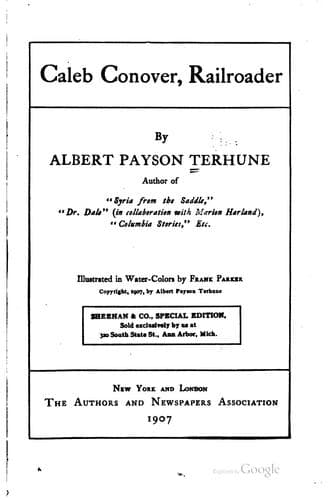
American fiction -- 20th century; Political fiction; Railroad stories; West (U.S.) -- Fiction
Inquiry showed that a break had occurred in the gas mains which could
not be remedied until morning. Candles and lamps were hurriedly sent
for. Meantime, though a certain confusion followed the plunging of the
place into darkness, the crowd had been, on the whole, orderly. In spite
of this, the chief of police, with twenty reserves, coming on the scene,
had ordered Standish civilly enough to dismiss the audience. Then the
policemen had filed up on the stage, illumining it by their bull’s-eye
lanterns, and clustered ominously about the speakers.
In response to Clive’s angry protest, the chief had simply reiterated
his order, adding that his department was responsible for the city’s
peace and quiet, and that the crowd showed an inclination to riot. Nor
could the Arm of the Law be shaken from this stand. The audience, during
the colloquy between Standish and the chief had grown impatient, and an
occasional catcall or shrill whistle had risen from the darkened
auditorium. At each of these sounds the police had gripped their
nightsticks and glanced with a fine apprehension at their leader for
commands.
The upshot of the matter had been the forced dismissal of the
spectators. Standish had scouted Ansel’s suggestion that the whole
catastrophe was a ruse of Conover’s, until, as he walked down the dark
aisle toward the door, he heard a policeman whisper:
“I was waitin’ for the chief to give some of us the tip to pinch him.”
“An’ let him make a noise like a martyr?” grunted a second voice easily
recognized as Billy Shevlin’s. “You must think the Boss is as balmy in
the belfry as you blue lobsters. He’d ’a’ had Geoghegan broke if he’d——”
The rest of the reply had been lost.
No other disengaged hall could be found in the vicinity; and the meeting
from which Clive had expected so much had gone by the board. He walked
home in a daze of chagrin. How could he hope to fight a man who employed
such weapons; who swayed such power in every city department; who thus
early in the campaign showed plainly he would stop at nothing in beating
his opponent?
Then the young candidate’s teeth clenched tight, and the sullen grit
that for so many centuries has carried the bulldog race of
yellow-haired, strong-jawed Anglo-Saxons to victory against hopeless
odds came to his aid. He shook his big shoulders as if tossing off some
physical weight, entered his rooms and switched on the electric light.
On his study table lay a special delivery letter, neatly typewritten, as
was the single long sheet of foolscap it contained. Standish glanced at
the bottom of the page. There was no signature. Then he read:
Public-domain text, read in full here on John Shaqi.
Reviews
Reviews
No reviews yet
Be the first to share your thoughts on this work.
Join the Discussion
Join the discussion
Sign in to leave a comment or review.
Sign InorCreate an account