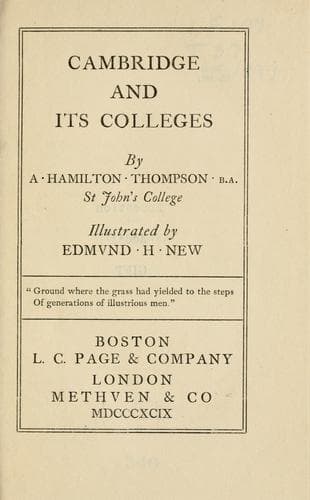
Cambridge and Its CollegesThompson, A. Hamilton (Alexander Hamilton)
History
Cambridge and Its Colleges
Thompson, A. Hamilton (Alexander Hamilton)
University of Cambridge
In examining the motives which led to the foundation of the various
colleges, it is interesting to observe how many of them were suggested by
similar and almost contemporary foundations at Oxford. One may safely say
that the boundary-line between the middle ages and the new learning of
the Renaissance was crossed when William of Wykeham founded his colleges
of St Mary at Winchester and Oxford. The political importance of William
of Wykeham and of his successors in the see of Winchester made their work
very conspicuous: two of them, William of Waynflete and Richard Foxe,
during their tenure of the see, proved no less munificent benefactors to
Oxford than Wykeham had been. The connection of the see of Winchester
with the Renaissance forced itself upon everybody’s attention. Henry VI.
was especially impressed with it. Two bishops, Cardinal Beaufort and
Waynflete, played a prominent part at his court; and it is to the latter
that we doubtless owe many hints for the foundation of King’s College.
However, at first, Henry VI. undertook the work without any idea of
uniting it with his school at Eton. The college which he incorporated in
1440 was a very humble affair. It was restricted to a master and twelve
scholars, and the space chosen for it was small and inconvenient. One
of the main arteries of Cambridge ran west of it; the whole site of the
present buildings was blocked up with houses; the form of the court had
to be adapted to its narrow and cramped position. But, two years later,
the king’s plans matured. His foundation of 1443 took a much larger
form. It converted King’s into a finishing-school, as it were, for his
Highness’ poor scholars of Eton. The dedication of the college was
changed. Hitherto, in reference to the saint who presided over Henry’s
birthday, it had been called the King’s College of St Nicholas. It now
added St Mary, the patroness of Eton, to its title. Thus it became an
exact counterpart of New College at Oxford. Although Henry projected his
buildings on a far more magnificent scale than anything of which Wykeham
had dreamed, they had nevertheless a certain resemblance to the Oxford
buildings. The plan includes a great tower and a cloister west of it,
such as were built at Oxford. On the whole, the Founder must have been
thinking very closely of the colleges at Winchester and Oxford, when he
set his hand to this splendid work. He made Waynflete, then Warden of
Winchester, Provost of Eton; and Waynflete was the guiding spirit of the
charter by which the two communities were regulated.[4]
Public-domain text, read in full here on John Shaqi.
Reviews
Reviews
No reviews yet
Be the first to share your thoughts on this work.
Join the Discussion
Join the discussion
Sign in to leave a comment or review.
Sign InorCreate an account