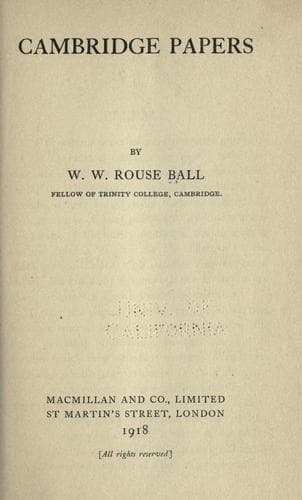
Cambridge PapersBall, W. W. Rouse (Walter William Rouse)
History
Cambridge Papers
Ball, W. W. Rouse (Walter William Rouse)
Trinity College (University of Cambridge); University of Cambridge -- History
Edward VI ascended the throne in 1547, and barely had the interior of
the chapel of King's Hall been adapted to the needs of the new
foundation than the College was required to remove all popish traces
from it. The altar and steps were taken down, and a communion table
set up, most likely in the middle of the chapel. The books, copes,
vestments, and altar ornaments which had come down from old times were
sold: they realized no less than £140. 8s. 8d., and the magnitude of
the sum obtained in such unfavourable conditions shows that the
services must have been conducted with considerable pomp. There is
to-day in the library a standing censer boat, ascribed to the end of
the fourteenth century or the early years of the fifteenth century,
with traces on it of its ancient gilding, but there is no record as to
how or when it came to us. King's Hall did in fact own among its
chapel vessels a "ship of silver" which probably means a censer boat,
and it may be that this is the vessel in question. With this possible
(but doubtful) exception all our medieval chapel plate has gone.
When in 1553 Mary succeeded her brother, the Roman religion was
restored, and the chapel again adapted to the old forms of worship.
Perhaps remonstrance was made by the master, Bill, who had been
appointed in 1551 on Redman's death and was a strong Anglican: at any
rate he was deprived of his office. The expulsion was dramatic and
apparently physical, for as he was sitting in his stall in the chapel
two members of the House, Mr Boys and Mr Gray, approached and "removed
him ... in a rude and insolent way." Declining any contest he retired
to Bedfordshire, and was succeeded as master by Christopherson, the
queen's chaplain and confessor.
Mary recognized the interest taken by her father in Trinity and, in
furtherance of his design, decided to rebuild the College on a
comprehensive plan. She issued orders about this on 24 October 1554,
and it was arranged in 1555 that the first large task undertaken in
connection with it should be the erection of a new chapel. Preliminary
work on this was commenced in 1556 and it was then expected that the
building would be finished by the end of 1557, but by October of that
year the walls were only half-way up: delays ensued and ten years
elapsed before the building was completed. The old chapel was unroofed
in 1561, and cannot, it would seem, have been used after that date: it
is possible it was shut up in the course of 1557, but early in that
year it was still in use, for the royal commissioners in January 1557
complained of the absence of lights on the altar and of coals to cense
the sacrament. During the years from the closing of the old chapel to
1567 it is uncertain whether the services were held in College or in
one of the town churches.
Public-domain text, read in full here on John Shaqi.
Reviews
Reviews
No reviews yet
Be the first to share your thoughts on this work.
Join the Discussion
Join the discussion
Sign in to leave a comment or review.
Sign InorCreate an account