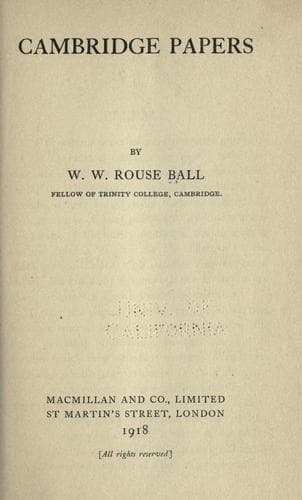
Cambridge PapersBall, W. W. Rouse (Walter William Rouse)
History
Cambridge Papers
Ball, W. W. Rouse (Walter William Rouse)
Trinity College (University of Cambridge); University of Cambridge -- History
This evening I was at Trinity Colledge Chapple where there was so
great a crowd that nothing could be heard of the whole service, I
could see the Readers lips go, but, not so much as heare the least
sound of his voice, and when Dr Walker read the 2d Leason could I
only heare the sound of his voice but not to distinguish one word.
There was great difference in the Musick part from what used to be,
for the symphony was first by the Organ and then by 6 violins in
3 parts to all which the Organ was the base. After the reading the
first and 2nd Lessons, 3 men sang the [blank] to which the Choire
was the Corus. Before the Prayer for the King there was another
Symphony by the Organ, & Violins, and the Anthem was Sung by one
man, to which the choir was likewise the chorus.
Throughout most of the eighteenth century, a good many of the fellows
resident in Cambridge held livings in the vicinity. They were
accustomed to ride out on Sunday to their cures, hold services, and
return home to a comfortable supper the same evening, but in general
neglected their parishes during the rest of the week. Thus if a
parishioner died, the funeral was deferred till the following Sunday;
and if a marriage-service was to be held in the village, it had to
wait for a free Sunday. In these circumstances the bride and
bridegroom often settled the matter by coming into Cambridge for the
ceremony, and during the first half of this century our chapel was
constantly borrowed for such marriage services; after the Marriage Act
of 26 George II, cap. 33, this use of it became illegal unless a
special license were obtained. Since that Act, it has been used only
once for such a purpose, namely, for the marriage of Miss Butler on
18 December 1901.
Coming to the nineteenth century, we have numerous notes about the
chapel and the services. At the beginning of this period the author of
_Alma Mater_ (J.M.F. Wright, who commenced residence in 1817) gives an
unfavourable account of the services, saying that they were gabbled
through as fast as possible amid a great deal of talking. The first
part of this statement may be correct, but as to the second probably
conversation was rare, and such as took place, though not condemned by
public opinion, was subdued and was held only in recesses, one of
which was known as iniquity corner. In fact, we may take it that the
vast majority of the undergraduates acted as gentlemen though they
attended chapel reluctantly and merely as a matter of discipline.
Attendance was required at seven o'clock in the morning, not a
convenient hour, albeit considerably later than that usual in Tudor
times.
Public-domain text, read in full here on John Shaqi.
Reviews
Reviews
No reviews yet
Be the first to share your thoughts on this work.
Elsewhere in the archive
Join the Discussion
Join the discussion
Sign in to leave a comment or review.
Sign InorCreate an account