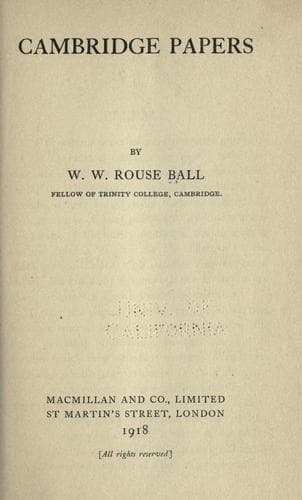
Cambridge PapersBall, W. W. Rouse (Walter William Rouse)
History
Cambridge Papers
Ball, W. W. Rouse (Walter William Rouse)
Trinity College (University of Cambridge); University of Cambridge -- History
Those who live among beautiful surroundings and in constant touch with
works of art are often apt to take their privileges for granted.
Members of Trinity are proud of the buildings of the College and the
grounds in which they are placed, and most of us know something of
their history and characteristic features. But with our art treasures
there is less general acquaintance, and so perhaps it may not be out
of place to jot down a few notes on some of them--chiefly pictures and
plate--in which I take pleasure.
Of the contents of the library I say nothing, for a volume would be
needed to describe them even briefly. The illuminated manuscripts and
the early printed books attract most attention, but there are numerous
other subjects in which the library must be ranked among the most
important in Great Britain. I have often been told by undergraduates
that they have never been in the building except once when they signed
the Admission Book. That is true enough of some men, but those who are
interested in rare and famous books and yet never visit the Library
neglect exceptional opportunities.
Of oil portraits--in all nearly two hundred--of former members of
the College, we own a valuable collection, and they illustrate in a
remarkable way how many distinguished men have been educated here.
Identification is easy as labels are placed on most of the pictures.
Unfortunately we have no gallery in which they can be shown. Some are
put in the hall, some in the master's lodge, some in the combination
room, and some in the library, lecture-rooms, etc. Those in the lodge
are set off well, but the others are not hung to advantage.
About twenty-five years ago a proposal was made to raise subscriptions
for an art gallery to be built along the edge of the river starting
from the present north end of the library and extending over the land
now occupied by the master's stables and the end of his garden. At
that time the proposal did not receive much favour, but now I
sometimes wonder if we were wise in putting the plan on one side.
Certainly we have more canvasses than we can exhibit satisfactorily.
The hall, too, would look a more dignified apartment if the pictures,
except for one or two on the dais, were taken away: recently their
temporary removal was necessitated by repairs to the woodwork, and the
improvement in the appearance of the room was noticeable. The general
effect of such a clearance may be judged by a visit to the hall of the
Middle Temple in London. The dimensions of the body of that hall are
the same as ours, but instead of pictures on the side walls, each
small oak panel bears an armorial shield: these harmonise well with
the architectural lines of the building. Where, as is the case with
our neighbours at St John's, the panelling is low and there is above
it a big stretch of stone or painted wall, pictures add to the effect,
but this is not the case where the panelling is high.
Public-domain text, read in full here on John Shaqi.
Reviews
Reviews
No reviews yet
Be the first to share your thoughts on this work.
Elsewhere in the archive
Join the Discussion
Join the discussion
Sign in to leave a comment or review.
Sign InorCreate an account