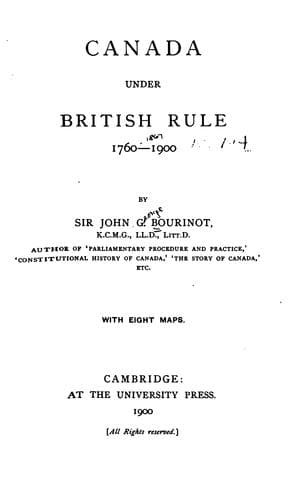
Canada under British Rule 1760-1900Bourinot, John George
History
Canada under British Rule 1760-1900
Bourinot, John George
Canada -- History
The stamp act was only evidence of a vigorous colonial policy, which was
to make the people of the colonies contribute directly to their own
defence and security, and at the same time enforce the navigation laws
and acts of trade and put an end to the general system of smuggling by
which men, some of the best known merchants of Boston, had acquired a
fortune. George Grenville, who was responsible for the rigid enforcement
of the navigation laws and the stamp act, had none of that worldly
wisdom which Sir Robert Walpole showed when, years before, it was
proposed to him to tax the colonies. "No," said that astute politician,
"I have old England set against me already, and do you think I will have
New England likewise?" But Grenville and his successors, in attempting
to carry out a new colonial policy, entirely misunderstood the
conditions and feelings of the colonial communities affected and raised
a storm of indignation which eventually led to independence. The stamp
act was in itself an equitable measure, the proceeds of which were to be
exclusively used for the benefit of the colonies themselves; but its
enactment was most unfortunate at a time when the influential classes in
New England were deeply irritated at the enforcement of a policy which
was to stop the illicit trade from which they had so largely profited in
the past. The popular indignation, however, vented itself against the
stamp act, which imposed internal taxation, was declared to be in direct
violation of the principles of political liberty and self-government
long enjoyed by the colonists as British subjects, and was repealed as a
result of the violent opposition it met in the colonies. Parliament
contented itself with a statutory declaration of its supremacy in all
matters over every part of the empire; but not long afterwards the
determination of some English statesmen to bring the colonies as far as
practicable directly under the dominion of British law in all matters of
commerce and taxation, and to control their government as far as
possible, found full expression in the Townshend acts of 1767 which
imposed port duties on a few commodities, including tea, imported into
those countries. At the same time provision was made for the due
execution of existing laws relating to trade. The province of New York
was punished for openly refusing to obey an act of parliament which
required the authorities to furnish the British troops with the
necessaries of life. Writs of assistance, which allowed officials to
search everywhere for smuggled goods, were duly legalised. These writs
were the logical sequence of a rigid enforcement of the laws of trade
and navigation, and had been vehemently denounced by James Otis, so far
back as 1761, as not only irreconcilable with the colonial charters, but
as inconsistent with those natural rights which a people "derived from
nature and the Author of nature"--an assertion which obtained great
prominence for the speaker.
Public-domain text, read in full here on John Shaqi.
Reviews
Reviews
No reviews yet
Be the first to share your thoughts on this work.
Join the Discussion
Join the discussion
Sign in to leave a comment or review.
Sign InorCreate an account