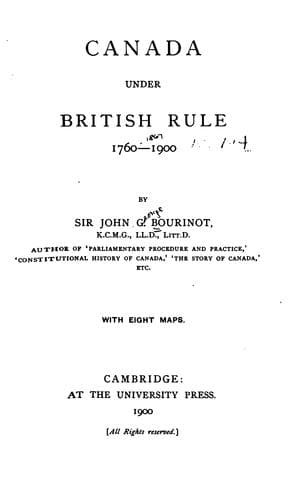
Canada under British Rule 1760-1900Bourinot, John George
History
Canada under British Rule 1760-1900
Bourinot, John George
Canada -- History
This bold expression of opinion in
Massachusetts should be studied by the historian of those times in
connection with the equally emphatic revolutionary argument advanced by
Patrick Henry of Virginia, two years later, against the ecclesiastical
supremacy of the Anglican clergy and the right of the king to veto
legislation of the colony. Though the prerogative of the crown was thus
directly called into question in a Virginia court, the British
government did not take a determined stand on the undoubted rights of
the crown in the case. English statesmen and lawyers probably regarded
such arguments, if they paid any attention to them at all in days when
they neglected colonial opinion, as only temporary ebullitions of local
feeling, though in reality they were so many evidences of the opposition
that was sure to show itself whenever there was a direct interference
with the privileges and rights of self-governing communities. Both Henry
and Otis touched a key-note of the revolution, which was stimulated by
the revenue and stamp acts and later measures affecting the colonies.
It is somewhat remarkable that it was in aristocratic Virginia, founded
by Cavaliers, as well as in democratic Massachusetts, founded by
Puritans, that the revolutionary element gained its principal strength
during the controversy with the parent state. The makers of
Massachusetts were independents in church government and democrats in
political principle. The whole history of New England, in fact, from the
first charters until the argument on the writs of assistance, is full of
incidents which show the growth of republican ideas. The Anglican church
had no strength in the northern colonies, and the great majority of
their people were bitterly opposed to the pretensions of the English
hierarchy to establish an episcopate in America. It is not therefore
surprising that Massachusetts should have been the leader in the
revolutionary agitation; on the other hand in Virginia the Anglican
clergy belonged to what was essentially an established church, and the
whole social fabric of the colony rested on an aristocratic basis. No
doubt before the outbreak of the revolution there was a decided feeling
against England on account of the restrictions on the sale of tobacco;
and the quarrel, which I have just referred to, with respect to the
stipends of the clergy, which were to be paid in this staple commodity
according to its market value at the time of payment, had spread
discontent among a large body of the people. But above all such causes
of dissatisfaction was the growing belief that the political freedom of
the people, and the very existence of the colony as a self-governing
community, were jeopardised by the indiscreet acts of the imperial
authorities after 1763. It is easy then to understand that the action of
the British government in 1767 renewed the agitation, which had been
allayed for the moment by the repeal of the stamp act and the general
Public-domain text, read in full here on John Shaqi.
Reviews
Reviews
No reviews yet
Be the first to share your thoughts on this work.
Join the Discussion
Join the discussion
Sign in to leave a comment or review.
Sign InorCreate an account