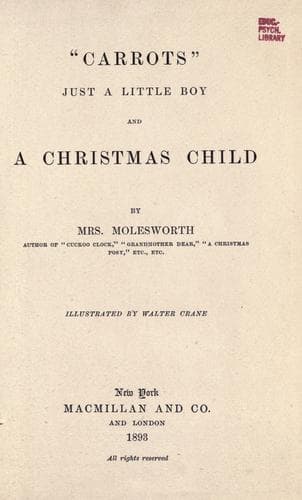
Boys -- Juvenile fiction; Children's stories; Families -- Juvenile fiction
"I didn't think hills were so big, or that they would have so many
faces," he said to Floss and Sybil the first morning when they were out
in the garden together.
Sybil burst out laughing. "Oh you funny Carrots!" she said; "you're just
like a boy in a fairy story--you've got such queer fancies."
"But they're _not_ fancies, Sybil," said Carrots, gravely, turning his
great brown eyes on his cousin. "The hills _have_ got lots of different
faces: that one up there, the one with the round knobby top, has looked
_quite_ different several times this morning. First it looked smiley and
smooth, and then it got all cross and wrinkly, and _now_ it looks as if
it was going to sleep."
Sybil stared up at the hill he was pointing to. "I see what you mean,"
she said; "but it's only the shadows of the clouds."
"That's pretty," said Carrots: "who told you that, Sybil? I never
thought of clouds having shadows."
"Nobody told me," said Sybil; "I finded it out my own self. I find out
lots of things," she continued, importantly. "I dare say it's because of
my name--papa says my name means I _should_ find out things, like a sort
of a fairy, you know."
"Does it?" said Carrots, in a rather awe-struck tone. "I should like
that. When you were little, Sybil," he continued, "were you ever
frightened of shadows? _I_ was."
"No," said Sybil, "I only thought they were funny. And once papa told me
a story of a shadow that ran away from its master. It went across the
street, at night, you know, when the lamps were lighted: there were
houses opposite, you see, and the shadow went into such a beautiful
house, and wouldn't come back again!"
"And what after that?" said both Floss and Carrots in a breath.
"Oh, I can't tell it you all," said Sybil; "you must ask papa."
"Does he often tell you stories?" asked Floss.
"Bits," said Sybil; "he doesn't tell them all through, like mother. But
he's very nice about answering things I ask him. He doesn't say 'you
couldn't understand,' or 'you'll know when you're older,' that _horrid_
way."
"He must be nice," said Floss, who had secretly been trembling a little
at the thought of the strange uncle.
And he did turn out _very_ nice. He was older than Floss had expected; a
good deal older than auntie, whom he sometimes spoke to as if she were
quite a little girl, in a way which amused the children very much. At
first he seemed very quiet and grave, but after a while Floss found out
that in his own way he was very fond of fun, and she confided to auntie
that she thought he was the funniest person she had ever seen. I don't
know if auntie told him this, or if he took it as a compliment, but
certainly he could not have been offended, for every day, as they
learnt to know him better, the children found him kinder and kinder.
So they were very happy at Greenmays, and no doubt would have gone on
being so but for one thing. There came bad news of their mother.
Public-domain text, read in full here on John Shaqi.
Reviews
Reviews
No reviews yet
Be the first to share your thoughts on this work.
Join the Discussion
Join the discussion
Sign in to leave a comment or review.
Sign InorCreate an account