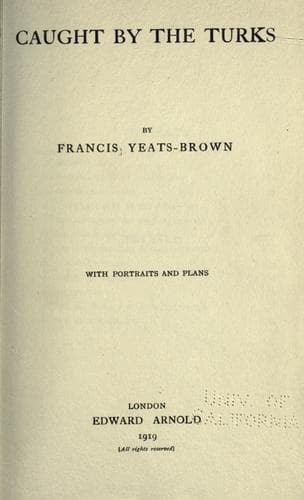
World War, 1914-1918 -- Prisoners and prisons, Turkish
That evening at sunset we were in the garden, looking across the blue
waters of the Marmora to the mosques and minarets of old Stamboul,
flushed with the loveliest tints of pink.
It was the last evening but one of Ramazan. To-morrow the crescent of
the new moon would appear over the dome of San Sofia, as a sign to all
that the fast had ended, and the time of rejoicing come. Between that
moon and the next moon an unknown future lay before us. And whatever our
fate, it was sure to be something exciting.
CHAPTER VIII
OUR FIRST ESCAPE
Our crossing from Haidar Pasha to the garrison camp at Psamattia was a
tame affair. Early in the day we had made up our minds that it would be
unwise to escape, as well as unkind to our indulgent sentries: unwise,
because we realised that if we bolted blindly from a restaurant, we
would probably be caught at the first lodging-house at which we tried to
gain admission; and unkind because, in common chivalry, we decided that
our sentries were too trustful to be drugged.
Our day, therefore, was spent in seeing the sights of Pera, gossiping
over a cocktail bar, purchasing some illicit maps under cover of a large
quantity of German publications, and generally learning the lie of the
land. But it might be indiscreet even at this distance of time to
describe in too great detail the sources from which we obtained our
information. One name, however--like King Charles' head with Mr.
Dick--will keep coming into this book. I cannot keep it out, because it
is impossible to think of my escape and escapades without thinking of
the gallant lady who made them possible.
Miss Whitaker, as she then was (she is now Lady Paul), knew something
about all the escapes which took place in Turkey, and a great deal about
a great many of them. Against every kind of difficulty from foes, and
constant discouragement from friends[6] she boldly championed the cause
of our prisoners through the dark days of 1916 and 1917. She visited the
sick in hospital, she carried plum puddings to our men working at San
Stefano, she was a never-failing source of sympathy and encouragement.
She sent messages for us, and wrote letters, and lent us money and
clothes. She was the good angel of the English at Constantinople, a
second--and more fortunate--Miss Cavell.
And she was the _Deus ex machina_ of my escapes. Having said this, I
will say one thing more. I cannot here put down one-tenth of the daring
work that Lady Paul did for me and others. The reason may be obvious to
the reader; at any rate it is binding on me to say far less than I would
wish.
Public-domain text, read in full here on John Shaqi.
Reviews
Reviews
No reviews yet
Be the first to share your thoughts on this work.
Elsewhere in the archive
Join the Discussion
Join the discussion
Sign in to leave a comment or review.
Sign InorCreate an account