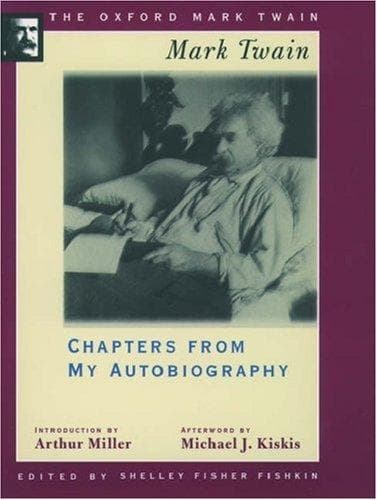
Authors, American -- 19th century -- Biography; Humorists, American -- 19th century -- Biography; Twain, Mark, 1835-1910
By grace of these truly wise and excellent instructions, Joe tumbled
Fitch down next morning with a bullet through his lower leg, which
furnished him a permanent limp. And Joe lost nothing but a lock of hair,
which he could spare better then than he could now. For when I saw him
here in New York a year ago, his crop was gone: he had nothing much left
but a fringe, with a dome rising above.
[Sidenote: (1864.)]
About a year later I got _my_ chance. But I was not hunting for it.
Goodman went off to San Francisco for a week's holiday, and left me to
be chief editor. I had supposed that that was an easy berth, there being
nothing to do but write one editorial per day; but I was disappointed in
that superstition. I couldn't find anything to write an article about,
the first day. Then it occurred to me that inasmuch as it was the 22nd
of April, 1864, the next morning would be the three-hundredth
anniversary of Shakespeare's birthday--and what better theme could I
want than that? I got the Cyclopaedia and examined it, and found out who
Shakespeare was and what he had done, and I borrowed all that and laid
it before a community that couldn't have been better prepared for
instruction about Shakespeare than if they had been prepared by art.
There wasn't enough of what Shakespeare had done to make an editorial of
the necessary length, but I filled it out with what he hadn't
done--which in many respects was more important and striking and
readable than the handsomest things he had really accomplished. But next
day I was in trouble again. There were no more Shakespeares to work up.
There was nothing in past history, or in the world's future
possibilities, to make an editorial out of, suitable to that community;
so there was but one theme left. That theme was Mr. Laird, proprietor of
the Virginia "Union." _His_ editor had gone off to San Francisco too,
and Laird was trying his hand at editing. I woke up Mr. Laird with some
courtesies of the kind that were fashionable among newspaper editors in
that region, and he came back at me the next day in a most vitriolic
way. He was hurt by something I had said about him--some little thing--I
don't remember what it was now--probably called him a horse-thief, or
one of those little phrases customarily used to describe another
editor. They were no doubt just, and accurate, but Laird was a very
sensitive creature, and he didn't like it. So we expected a challenge
from Mr. Laird, because according to the rules--according to the
etiquette of duelling as reconstructed and reorganized and improved by
the duellists of that region--whenever you said a thing about another
person that he didn't like, it wasn't sufficient for him to talk back in
the same offensive spirit: etiquette required him to send a challenge;
so we waited for a challenge--waited all day. It didn't come. And as the
day wore along, hour after hour, and no challenge came, the boys grew
depressed. They lost heart. But I was cheerful; I felt better and better
Public-domain text, read in full here on John Shaqi.
Reviews
Reviews
No reviews yet
Be the first to share your thoughts on this work.
Elsewhere in the archive
Join the Discussion
Join the discussion
Sign in to leave a comment or review.
Sign InorCreate an account