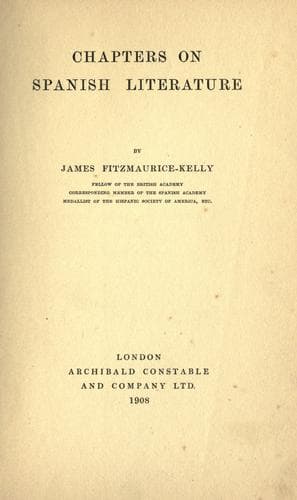
Chapters on Spanish LiteratureFitzmaurice-Kelly, James
History
Chapters on Spanish Literature
Fitzmaurice-Kelly, James
Spanish literature; Spanish literature -- History and criticism
I must find time to say a few words about Juan Rodríguez de la Cámara
(also called, after his supposed birthplace in Galicia, Rodríguez
del Padrón), whose few scattered poems are mostly love-songs, less
scandalous than might be expected from such alarming titles as _Los
Mandamientos de Amor_ and _Siete Gozos de Amor_. Nothing in these
amatory lyrics is so attractive as the legend which has formed round
their author. He is supposed to have served in the household of
Cardinal Juan de Cervantes about the year 1434, to have travelled in
Italy and in the East, to have been page to Juan II., to have become
entangled at court in some perilous amour, to have brought about a
breach by his indiscreet revelations to a talkative friend, to have
fled into solitude, and to have become a Franciscan monk. Some such
story is adumbrated in Rodríguez de la Cámara’s novel _El Siervo libre
de Amor_, and the romantic part of it—the love-episode—is confirmed by
the official chronicler of the Franciscan Order. An anonymous writer
of the sixteenth century goes on to state that Rodríguez de la Cámara
went to France, became the lover of the French queen, and was killed
near Calais in an attempt to escape to England. The imaginative nature
of this postscript discredits the writer’s assertion that Rodríguez
de la Cámara’s mistress at the Spanish court was Queen Juana, the
second wife of Juan II.’s son, Enrique IV. Rightly or wrongly, Juana of
Portugal is credited with many lovers, but Rodríguez de la Cámara was
certainly not one of them. As _El Siervo libre de Amor_ was written not
later than 1439, the adventures recounted in it must have occurred—if
they ever occurred at all—before this date; but the future Enrique
IV. was first married in 1440 (to Blanca of Navarre), and his second
marriage (to Juana of Portugal) did not take place till 1455. A simple
comparison of dates is enough to ensure Juana’s acquittal. Few people
like to see a scandalous story about historical personages destroyed in
this cold-blooded way, and it has accordingly been suggested that the
heroine was Juan II.’s second wife, the Isabel of Portugal who brought
Álvaro de Luna to the scaffold. The substitution is capricious, but it
has a plausible air. Chronology, again, comes to the rescue. Rodríguez
de la Cámara became a monk before 1445, and Isabel of Portugal did not
marry Juan II. till 1447. The identity of the lady is even harder to
establish than that of the elusive Portuguese beauty celebrated during
the next century by Bernardim de Ribeiro in _Menina e Moça_.
Public-domain text, read in full here on John Shaqi.
Reviews
Reviews
No reviews yet
Be the first to share your thoughts on this work.
Join the Discussion
Join the discussion
Sign in to leave a comment or review.
Sign InorCreate an account