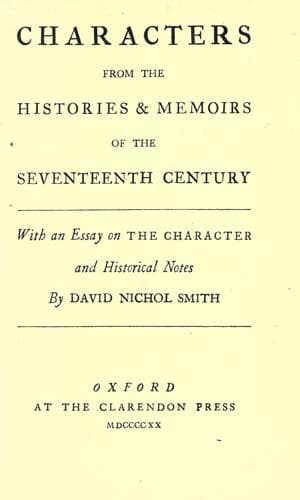
Characters from the Histories & Memoirs of the Seventeenth Century
History
Characters from the Histories & Memoirs of the Seventeenth Century
Great Britain -- Biography; Great Britain -- History -- Stuarts, 1603-1714
His single misfortune was (which indeede was productive of many
greater) that he never made a noble and a worthy frendshipp with a man
so neere his æquall, that he would frankely advize him, for his honour
and true interest, against the current, or rather the torrent of his
impetuous passyons: which was partly the vice of the tyme, when the
Courte was not replenished with greate choyce of excellent men, and
partly the vice of the persons, who were most worthy to be applyed
to, and looked upon his youth, and his obscurity, as obligations upon
him, to gayne ther frendshipps by extraordinary application; then his
ascent was so quicke, that it seemed rather a flight, then a growth,
and he was such a darlinge of fortune, that he was at the topp, before
he was seene at the bottome, for the gradation of his titles, was the
effecte, not cause of his first promotion, and as if he had bene borne
a favorite, he was supreme the first moneth he came to courte, and
it was wante of confidence, not of creditt, that he had not all at
first, which he obtayned afterwards, never meetinge with the least
obstruction, from his settinge out, till he was as greate as he could
be, so that he wanted dependants, before he thought he could wante
coadjutors; nor was he very fortunate in the election of those
dependants, very few of his servants havinge bene ever qualifyed
enough to assiste or advize him, and were intente only upon growinge
rich under [him], not upon ther masters growinge good as well as
greate, insomuch as he was throughout his fortune, a much wiser man,
then any servant or frende he had: Lett the faulte or misfortune be
what and whence it will, it may very reasonably be believed that if
he had bene blessed with one faythfull frende, who had bene qualifyed
with wisdome and integrity, that greate person would have committed
as few faults, and done as transcendant worthy actions, as any man
who shyned in such a sphere in that age, in Europe, for he was of
an excellent nature, and of a capacity very capable of advice and
councell; he was in his nature just and candid, liberall, generous,
and bountifull, nor was it ever knowne that the temptation of money
swayed him to do an unjust, or unkinde thinge, and though he left a
very greate inheritance to his heyres, consideringe the vast fortune
he inherited by his wife (the sole daughter and Heyre of Francis
Earle of Rutlande,) he owed no parte of it to his owne industry or
sollicitation, but to the impatient humour of two kings his masters,
who would make his fortune æquall to his titles, and the one above
other men, as the other was, and he considered it no otherwise then
as thers, and left it at his death ingaged for the crowne, almost to
the valew of it, as is touched upon before. If he had an immoderate
ambition, with which he was charged, and is a weede (if it be a weede)
apt to grow in the best soyles, it does not appeare that it was in
his nature, or that he brought it with him to the Courte, but rather
Public-domain text, read in full here on John Shaqi.
Reviews
Reviews
No reviews yet
Be the first to share your thoughts on this work.
Join the Discussion
Join the discussion
Sign in to leave a comment or review.
Sign InorCreate an account