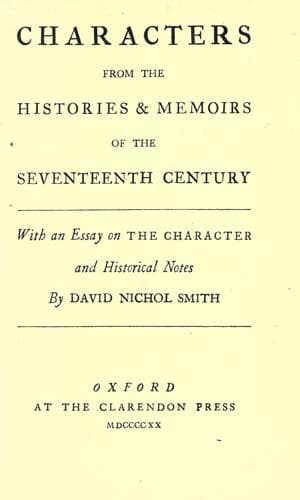
Characters from the Histories & Memoirs of the Seventeenth Century
History
Characters from the Histories & Memoirs of the Seventeenth Century
Great Britain -- Biography; Great Britain -- History -- Stuarts, 1603-1714
He was of an imperious nature, and nothinge wary in disoblieginge
and provokinge other men, and had to much courage in offendinge and
incensinge them, but after havinge offended and incensed them, he
was of so unhappy a feminine temper that he was always in a terrible
fright and apprehension of them. He had not that application, and
submissyon and reverence for the Queene as might have bene exspected
from his wisdome and breedinge, and often crossed her prætences and
desyres, with more rudenesse then was naturall to him; yett he was
impertinently sollicitous to know what her Majesty sayd of him in
private, and what resentments shee had towards him; and when by some
confidents (who had ther ends upon him from those offices) he was
informed of some bitter exspressions fallen from her Majesty, he was
so exceedingly afflicted and tormented with the sense of it, that
sometimes by passionate complaints and representations to the Kinge,
sometimes by more dutifull addresses and expostulations with the
Queene in bewaylinge his misfortunes, he frequently exposed himselfe,
and left his condition worse then it was before: and the eclarcicement
commonly ended in the discovery of the persons from whome he had
received his most secrett intelligence. He quickly lost the character
of a bold, stoute, and magnanimous man, which he had bene longe
reputed to be, in worse tymes, and in his most prosperous season, fell
under the reproch of beinge a man of bigg lookes, and of a meane and
abjecte spiritt....
To conclude, all the honours the Kinge conferred upon him, as he made
him a Barren, then an Earle, and Knight of the Gartar, and above
this, gave a younge, beautifull Lady, neerely allyed to him and to the
Crowne of Scotlande, in marriage to his eldest Sunn, could not make
him thinke himselfe greate enough; nor could all the Kings bountyes
nor his owne large accessions, rayse a fortune to his Heyre, but after
six or eight yeeres spent in outward opulency, and inward murmur and
trouble, that it was no greater, after vast summes of mony and greate
wealth gotten and rather consumed then injoyed, without any sense
or delight in so greate prosperity, with the agony that it was no
greater, He dyed unlamented by any, bitterly mentioned by most, who
never pretended to love him, and sevearely censured and complayned of,
by those who exspected most from him, and deserved best of him, and
left a numerous family, which was in a shorte tyme worne out, and yett
outlyved the fortune he left behinde him.
[Footnote 1: In the MS. the words 'he travelled into forrainge parts'
occur after 'Middle temple', as well as after 'constituted'. The whole
sentence is faulty. 'After this' is inserted in the edition of 1702
before 'he betooke'.]
[Footnote 2: 'as' inserted in late hand in MS. in place of 'and'.]
[Footnote 3: 'off' added in later hand in MS.; 'notice of', ll. 2, 6,
ed. 1704.]
6.
THE EARL OF ARUNDEL.
_Thomas Howard, fourteenth Earl of Arundel._
_Born 1586. Died 1646._
Public-domain text, read in full here on John Shaqi.
Reviews
Reviews
No reviews yet
Be the first to share your thoughts on this work.
Elsewhere in the archive
Join the Discussion
Join the discussion
Sign in to leave a comment or review.
Sign InorCreate an account