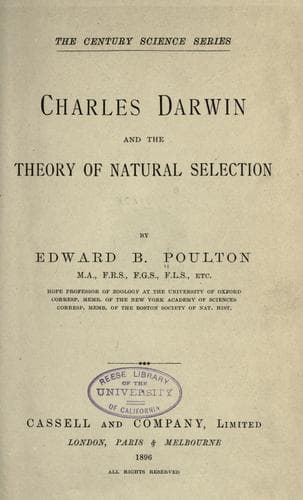
Charles Darwin and the Theory of Natural SelectionPoulton, Edward Bagnall, Sir
Science
Charles Darwin and the Theory of Natural Selection
Poulton, Edward Bagnall, Sir
Darwin, Charles, 1809-1882; Natural selection
“I hope it is a satisfaction to you to reflect--and very few
things in my life have been more satisfactory to me--that we have
never felt any jealousy towards each other, though in one sense
rivals. I believe that I can say this of myself with truth, and I
am absolutely sure that it is true of you.”
CHAPTER XII.
THE GROWTH OF WALLACE’S CONVICTIONS ON EVOLUTION AND DISCOVERY OF
NATURAL SELECTION--BORNEO 1855--TERNATE 1858.
We have already seen in the earlier part of this volume, the gradual
development of the theory of Natural Selection in the mind of Darwin,
and the long succession of experiments and observations which he
undertook before he could bring himself to publish anything upon the
subject, as well as the conditions which forced him to a hurried
publication in the end. It is of the deepest interest to compare with
this the account which Wallace has given us of the mental process by
which he arrived at the same conclusions.
This deeply interesting personal history has only been known during
the last few years; in 1891 Wallace republished his “Essays on Natural
Selection” in one volume, combined with “Tropical Nature,” and he has
added (on pp. 20, 21) the following introductory note to Chapter II.,
viz. the reprint of his Linnean Society Memoir “On the Tendencies of
Varieties to depart indefinitely from the Original Type.” The note is
here reprinted in full:--
“As this chapter sets forth the main features of a theory
identical with that discovered by Mr. Darwin many years before
but not then published, and as it has thus an historical
interest, a few words of personal statement may be permissible.
After writing the preceding paper [“On the Law which has
Regulated the Introduction of New Species”] the question of
_how_ changes of species could have been brought about was
rarely out of my mind, but no satisfactory conclusion was
reached till February 1858. At that time I was suffering from
a rather severe attack of intermittent fever at Ternate in the
Moluccas, and one day, while lying on my bed during the cold
fit, wrapped in blankets, though the thermometer was at 88°
Fahr., the problem again presented itself to me, and something
led me to think of the ‘positive checks’ described by Malthus
in his ‘Essay on Population,’ a work I had read several years
before, and which had made a deep and permanent impression on my
mind. These checks--war, disease, famine and the like--must, it
occurred to me, act on animals as well as man. Then I thought of
the enormously rapid multiplication of animals, causing these
checks to be much more effective in them than in the case of
man; and while pondering vaguely on this fact there suddenly
flashed upon me the _idea_ of the survival of the fittest--that
the individuals removed by these checks must be on the whole
Public-domain text, read in full here on John Shaqi.
Reviews
Reviews
No reviews yet
Be the first to share your thoughts on this work.
Join the Discussion
Join the discussion
Sign in to leave a comment or review.
Sign InorCreate an account