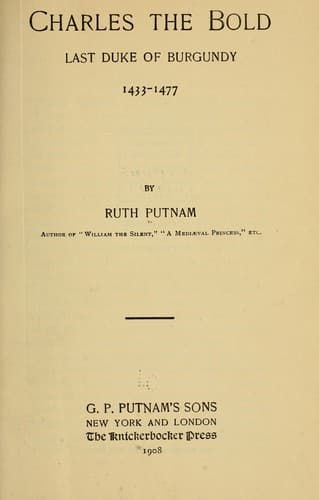
Charles the Bold, Last Duke of Burgundy, 1433-1477Putnam, Ruth
History
Charles the Bold, Last Duke of Burgundy, 1433-1477
Putnam, Ruth
Burgundy (France) -- History; Charles, Duke of Burgundy, 1433-1477; Switzerland -- History -- 1032-1499
Such, is La Marche's testimony.[1] Intact undoubtedly, but possibly
the satisfaction was not quite perfect. Du Clercq[2] declares that
Count Charles acquitted himself honourably of his charge and made
himself respected as a magistrate. Above all, he insisted that justice
should be dealt out to all alike. The only danger in his methods was
that he acted on impulse without sufficiently informing himself of the
matter in hand, or hearing both sides of a controversy. As a result,
his decisions were not always impartial and the father was preferred
to the strenuous and impetuous son. "Not that Philip was often
inclined to recognise other law than his own will, but he was more
tranquil, more gentle than his son, and more guided by reason," adds
a later author.[2] There was an evident dread as to what might be the
outcome of the count's untrained, youthful ardour.
The duke's chief measures after his return in February, 1455, seemed
hardly calculated to arouse any great personal devotion to himself or
a profound trust that his first consideration was for the advantage of
his Netherland subjects. His thoughts were still turned to the East,
and his main interest in the individual countships was as sources of
supply for his Holy War. Considerable sums flowed into his exchequer
that were never used for their destined purpose, but the duke cannot
be justly accused of actual bad faith in amassing them. His intention
to make the Eastern campaign remained firm for some years.
[Illustration: STATUE OF CHARLES THE BOLD AT INNSBRUCK]
In another matter, his despotic exercise of personal authority, far
without the pale of his jurisdiction inherited or acquired, shows no
shadow of excuse.
In the bishropic of Utrecht the ecclesiastical head was also lay
lord. Here the counts of Holland possessed no voice. They were near
neighbours, that was all. Philip ardently desired to be more in this
tiny independent state in the midst of territories acknowledging his
sway.
In 1455, the see of Utrecht became vacant and Philip was most anxious
to have it filled by his son David, whom he had already made Bishop of
Thérouanne by somewhat questionable methods. The Duke of Guelders
also had a neighbourly interest in Utrecht and he, too, had a pet
candidate, Stephen of Bavaria, whose election he urged. The chapter
resolutely ignored the wishes of both dukes and the canons were almost
unanimous in their choice of Gijsbrecht of Brederode.[4]
A very few votes were cast for Stephen of Bavaria, but not a single
one for David of Burgundy.
Brederode was already archdeacon of the cathedral and an eminently
worthy choice, both for his attainments and for his character. He was
proclaimed in the cathedral, installed in the palace, and confirmed,
as regarded his temporal power, by the emperor.
Public-domain text, read in full here on John Shaqi.
Reviews
Reviews
No reviews yet
Be the first to share your thoughts on this work.
Join the Discussion
Join the discussion
Sign in to leave a comment or review.
Sign InorCreate an account