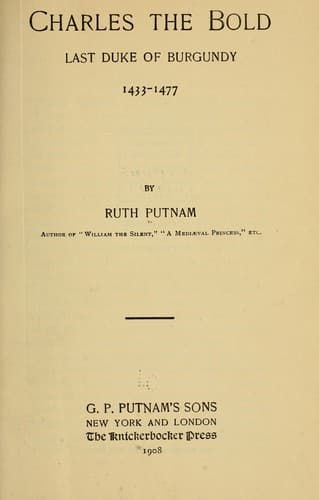
Charles the Bold, Last Duke of Burgundy, 1433-1477 — John Shaqi
Charles the Bold, Last Duke of Burgundy, 1433-1477Putnam, Ruth
History
Charles the Bold, Last Duke of Burgundy, 1433-1477
Putnam, Ruth
Burgundy (France) -- History; Charles, Duke of Burgundy, 1433-1477; Switzerland -- History -- 1032-1499
Philip, however, refused to accept the returns, although not a single
suffrage had been cast by the qualified electors for his son. He
despatched the Bishop of Arras to Rome to petition the new pope,
Calixtus III., to refuse to ratify the late election and to confer
the see upon David, out of hand. Philip's tender conscience found
Gijsbrecht ineligible to an episcopal office because he had
participated in the war against Ghent, certainly a weak plea in an age
of militant bishops!
The pope was afraid to offend the one man in Europe upon whose
immediate aid he counted in the Turkish campaign. He accepted the gift
of four thousand ducats offered by Gijsbrecht's envoys, the customary
gift in asking papal confirmation for a bishop-elect, but secretly
he delivered to Philip's ambassador letters patent creating David of
Burgundy Bishop of Utrecht.[5]
The Burgundian La Marche states euphemistically that David was elected
to the see, and the Deventer people would not obey him, therefore
Philip had to levy an army and come in person to support the new
bishop.[6] Du Clercq puts a different colour on the story and
d'Escouchy[7] implies that the whole trouble arose from party strife
which had to be quelled in the interests of law and order.
Apart from any question of insult to the Utrechters by imposing upon
them a spiritual director of acknowledged base birth, the right of
choice lay with them and the emperor had confirmed their choice as far
as the lay office was concerned. While the issue was undecided, the
Estates of Utrecht appointed Gijsbrecht guardian and defender of the
see to assure him a legal status pending the papal ratification. The
people were prepared to support their candidate with arms, a game that
Philip did not refuse, and the force of thirty thousand men with which
he invaded the bishopric proved the stronger argument of the two and
able to carry David of Burgundy to the episcopal throne, upon which he
was seated in his father's presence, October 16, 1455.
Some of Philip's allies reaped certain advantages from the situation.
Alkmaar and Kennemerland redeemed certain forfeited privileges by
means of their contributions to the duke's army. The city of Utrecht
preferred a compromise to the risk of war. The bishop-elect,
Gijsbrecht, consented to withdraw his claim, being permitted to retain
the humbler office of provost of Utrecht and an annuity of four
thousand guilders out of the episcopal revenues.
Deventer was the only place which was obstinate enough to persist in
her rebellion and Philip was engaged in bringing her citizens to terms
by a siege when news was brought to him that a visitor had arrived at
Brussels under circumstances which imperatively demanded his personal
attention.
Public-domain text, read in full here on John Shaqi.
Reviews
Reviews
No reviews yet
Be the first to share your thoughts on this work.
Join the Discussion
Join the discussion
Sign in to leave a comment or review.
Sign InorCreate an account