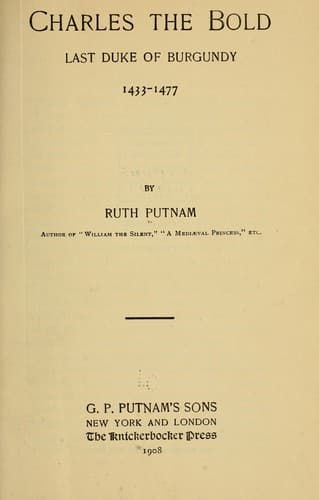
Charles the Bold, Last Duke of Burgundy, 1433-1477Putnam, Ruth
History
Charles the Bold, Last Duke of Burgundy, 1433-1477
Putnam, Ruth
Burgundy (France) -- History; Charles, Duke of Burgundy, 1433-1477; Switzerland -- History -- 1032-1499
Meanwhile, the Count of Dammartin was directed by the king to take
military possession of Dauphiné and to put the dauphin under arrest.
As he was _en route_ to fulfil these orders, the count heard that
a day had been set by Louis for a great hunt. That an excellent
opportunity might be afforded for securing his quarry in the course
of the chase, was the immediate thought of the king's lieutenant. So
there might have been had not the wily hunter received timely warning
of the project for making _him_ the game.
At the hour appointed for the meet, the dauphin's suite rode to the
rendezvous, but the prince turned his horse in the opposite direction
and galloped away at full speed, attended by a few trusty followers.
He hardly stopped even to take breath until he was out of his father's
domain, and made no pause until he reached St. Claude, a small town
in the Franche-Comté, where he threw himself on the kindness of the
Prince of Orange.
How gossip about this strange departure of the French heir fluttered
here and there! Du Clercq[13] tells the story with some variation from
the above outline, laying more stress on the popular appeal to the
king for relief from Louis's transgressions as governor of Dauphiné,
and enlarging on the accusation that Louis was responsible for the
death of _La belle Agnès_, "the first lady of the land possessing the
king's perfect love." He adds that the dauphin was further displeased
because the niece of this same Agnes, the Demoiselle de Villeclerc,
was kept at court after her aunt's death. Wherever the king went he
was followed by this lady, accompanied by a train of beauties. It was
this conduct of his father that had forced the son to absent himself
from court life for twelve years and more, during which time he
received no allowance as was his rightful due, and thus he had been
obliged to make his own requisitions from his seigniory.
There were other reports that the king was quite ready to accord his
son his full state; others, again, that Charles drove Louis into exile
from mere dislike and intended to make his second son his heir and
successor. At this point Du Clercq's manuscript is broken off abruptly
and the remainder of his conjectures are lost to posterity. Where the
text begins again, the author dismisses all this contradictory hearsay
and says in his own character as veracious chronicler, "I concern
myself only with what actually occurred. The dauphin gave a feast
in the forest and then departed secretly to avoid being arrested by
Dammartin."
This flight was the not unnatural termination of a long series of
misunderstandings between a father whose private conduct was not above
criticism, and a son, clever, unscrupulous, destitute of respect for
any person or thing except for the superstitious side of his religion.
Public-domain text, read in full here on John Shaqi.
Reviews
Reviews
No reviews yet
Be the first to share your thoughts on this work.
Join the Discussion
Join the discussion
Sign in to leave a comment or review.
Sign InorCreate an account