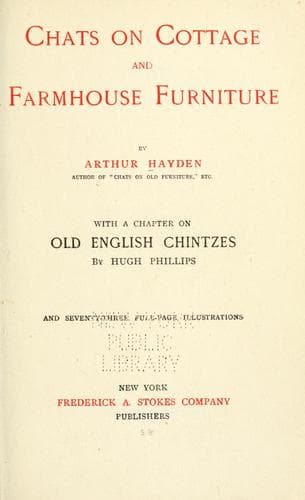
Chats on Cottage and Farmhouse FurnitureHayden, Arthur
History
Chats on Cottage and Farmhouse Furniture
Hayden, Arthur
Country furniture -- England; Furniture -- England; Textile fabrics -- England
The settle illustrated is a plainer variety of the settle made for
use by fashionable folk with delicately panelled back. Very often,
in cottage furniture, chests and other pieces are broken up to make
into smaller furniture or to be incorporated into furniture of a
later design. Often it is found that the underframing of an old
gate table made in the seventeenth or eighteenth century is from an
earlier chest. In the present instance it will be seen that the back
panels of the settle have been made from an older chest, which bears
the inscribed initials, still visible, "I.E." In date this settle
is about 1675, and is contemporary with the square-backed chair
illustrated on the same page. Here the panel in back projects, that
is, it is slightly bevelled forward. The bevelling of the panel is
always a sign that a chair is later in date than the year 1670.
Illustrated on the same page is a remarkable chair having the
initials "A.S.C.B." and the date 1777 carved on it. It is a striking
instance of the adherence to old time-honoured form by the local
cabinet-maker, with touches that, even although the date were not
present, would tell their own story. This dull wood proclaims a
message in accents no less sure than the sturdy yeoman's to Lady
Clara Vere de Vere, and as a chair in date _anno Domini_ 1777 may
afford to "smile at the claims of long descent" of more pretentious
and fashionable furniture. It is like a rich vein of dialect running
in some old country song ripe with phrase of Saxon days. It seems
incredible that this survival of early-Jacobean days should have been
put together by a village craftsman true to convention and exact in
seat and arms and stretcher. But it was not done unthinkingly. Here
is a chair, astounding to note, made when Sheraton was creating
his new styles to supplant Chippendale, and when Hepplewhite stood
between the two masters as a _via media_. And the back of this
village chair has two distinct features translated from Hepplewhite's
school--the wheatear crest and the panel with its broken corner!
[Illustration: OAK CHAIRS. DATE ABOUT 1680.
Showing the inclination of the craftsmen to assimilate designs
then being fashioned in walnut.
(_By the courtesy of Messrs. Phillips, Hitchin._)]
Public-domain text, read in full here on John Shaqi.
Reviews
Reviews
No reviews yet
Be the first to share your thoughts on this work.
Elsewhere in the archive
Join the Discussion
Join the discussion
Sign in to leave a comment or review.
Sign InorCreate an account