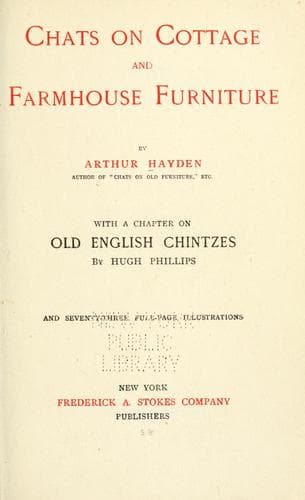
Chats on Cottage and Farmhouse FurnitureHayden, Arthur
History
Chats on Cottage and Farmhouse Furniture
Hayden, Arthur
Country furniture -- England; Furniture -- England; Textile fabrics -- England
It will be seen that these three chairs, each in varying manner,
evade the difficulties of the light cane-back by the substitution of
thin rails, and, as will be seen from the illustration of three other
chairs (p. 209), the next stage of walnut design with fiddle-shaped
splat offered equal problems to the makers of cottage furniture.
Sometimes they eliminated the splat altogether, while adopting other
points of design found in chairs with the Queen Anne splat of 1710.
In every case the fondness for old established styles is exhibited
in the fact that the country cabinet-maker clings doggedly to these
and appears too conservative or too timid to break wholly away from
tradition. In consequence, his work, with patches of newer design
welded on to the old, is quaintly incongruous. There is thus an
absence of "thinking out" the design as a whole. The minor maker
thought out the parts as he went along. Some of his results are
extraordinary in their characteristics: they resemble that freak of
fashion termed "harlequin" tea services, where the cups are of one
pattern and the saucers of another. Bearing in mind these unfailing
proclivities of the maker of cottage and farmhouse furniture, the
collector should not find it difficult to recognise the country hand
at once. Now and again one is struck with the extraordinary ingenuity
of some of the work, or one is charmed with the faithfulness with
which designs have been translated from the golden bowl to the
silver, or, to be literal, from walnut and mahogany to oak and elm
and beech. But one is never amazed at the delicacy of proportion, the
balanced symmetry, or the fertility of invention--these attributes
belong to cabinet-makers on a higher plane.
Of three chairs illustrated on p. 209, that on the left in the legs
and seat shows the moribund Jacobean style. The stretcher indicates
the oncoming of the newer styles, and the back with its cresting
rail is of the Charles II. period. Its retention is curious, and the
perforated arched centre is peculiar to designs found in walnut; its
use in oak by the maker of this chair was a blunder, as oak is too
hard a wood to employ for such a design.
[Illustration: QUEEN ANNE CHAIR.
Entirely oak form except back and splat.]
[Illustration: QUEEN ANNE CHAIR.
In oak, with strong inclinations towards walnut styles.]
Illustration: QUEEN ANNE CHAIR.
Walnut design made in oak for farmhouse use.]
[Illustration: QUEEN ANNE ARM-CHAIR.
With shaped front, walnut design executed in oak.
(_By the courtesy of Messrs. Phillips, Hitchin._)]
[Illustration: COUNTRY CHIPPENDALE CHAIR, STYLE MERGING INTO
HEPPLEWHITE.
Less pronounced Cupid's bow top.]
[Illustration: TWO CHAIRS COUNTRY HEPPLEWHITE STYLE MADE ENTIRELY
IN OAK.
Left-hand chair with Prince of Wales's feathers.]
[Illustration: TYPES OF COTTAGE CHAIRS IN OAK.
Having features of the three styles--Queen Anne, Chippendale, and
Sheraton.
Public-domain text, read in full here on John Shaqi.
Reviews
Reviews
No reviews yet
Be the first to share your thoughts on this work.
Elsewhere in the archive
Join the Discussion
Join the discussion
Sign in to leave a comment or review.
Sign InorCreate an account