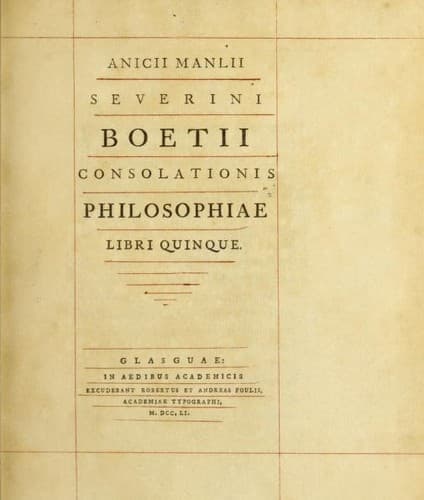
Chaucer's Translation of Boethius's "De Consolatione Philosophiae"Boethius
ReligionComparative
Chaucer's Translation of Boethius's "De Consolatione Philosophiae"
Boethius
Happiness; Philosophy and religion
¶ Þo saide sche þus. wheþer wenest þou q{uo}d
sche þ{a}t þis worlde be gouerned by foolisshe happes
{and} fortunes. or elles wenest þou þat þer be i{n} it any 636
gouerneme{n}t of resou{n}.
[Sidenote: _B._ By no means. The Creator presides over his own
works.]
Certes q{uod} .I. ne trowe not
in no manere þat so certeyne þinges scholde be moeued
by fortunouse fortune. but I wot wel þat god maker
{and} mayster is gouerno{ur} of þis werk.
[Sidenote: I shall never swerve from this opinion.]
Ne neuer nas 640
ȝit day þat myȝt[e] putte me oute of þe soþenesse of
þat sentence.
[Sidenote: _P._ Yes! Thou didst say as much when thou didst
declare man alone to be destitute of divine care.]
¶ So is it q{uod} sche. for þe same þing
songe þou a lytel here byforne {and} byweyledest {and}
byweptest. þat only men weren put oute of þe cure of 644
god. ¶ For of alle oþer þinges þou ne doutest nat
þat þei nere gouerned by reso{n}.
[Sidenote: Still thou seemest to labour under some defect even in
this conviction.]
but how (.i. pape.).
I wondre gretly certes whi þat þou art seek. siþen þou
art put in to so holesom a sentence. but lat vs seken 648
depper. I coniecte þat þere lakkeþ I not what. [[pg 27]]
[Sidenote: Tell me how the world is governed.]
but sey me þis. siþen þat þou ne doutest nat þ{a}t þis worlde
be gouerned by god ¶ wiþ swycche gouernailes takest
þou hede þat it is gouerned.
[Sidenote: _B._ I do not thoroughly comprehend your question.]
¶ vnneþ q{uod} .I. knowe 652
.I. þe sente{n}ce of þi q{ue}stiou{n}. so þat I ne may nat
ȝit answeren to þi demaundes.
[Sidenote: _P._ I was not deceived, then, when I said there was
some defect in thy sentiment.]
¶ I nas nat deceiued
q{uod} sche þat þere ne faileþ su{m}what. by whiche þe
maladie of p{er}turbac{i}ou{n} is crept in to þi þouȝt. so 656
as þe strengþe of þe paleys schynyng is open.
[Sidenote: Tell me what is the chief end of all things; and
whither all things tend.]
¶ But
seye me þis reme{m}brest þou ouȝt what is þe ende of
þi þinges. whider þat þe entenc{i}ou{n} of al kynde tendeþ.
¶ I haue herd told it somtyme q{uod} .I. but drerynesse 660
haþ dulled my memorie. ¶ Certys q{uod} sche
þou wost wel whe{n}nes þat alle þinges ben comen {and}
p{ro}ceded.
[Sidenote: _B._ God is the beginning of all things.]
I wot wel q{uod} .I. {and} ansewered[e] þat
god is þe bygynnyng of al.
[Sidenote: _P._ How, then, art thou ignorant of their end?]
¶ And how may þis be 664
q{uod} sche þat siþen þ{o}u knowest þe bygynnyng of
þinges. þat þou ne knowest not what is þe endyng of
þinges.
Public-domain text, read in full here on John Shaqi.
Reviews
Reviews
No reviews yet
Be the first to share your thoughts on this work.
Elsewhere in the archive
Join the Discussion
Join the discussion
Sign in to leave a comment or review.
Sign InorCreate an account