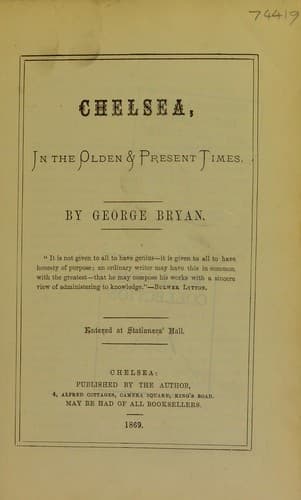
Chelsea, in the Olden & Present TimesBryan, George
History
Chelsea, in the Olden & Present Times
Bryan, George
Chelsea (London, England) -- History
The Dowager Viscountess Cremorne, born in Philadelphia in 1740, died at
her house in Stanhope Street in 1825, in the 86th year of her age. Her
ladyship resided at Chelsea a great portion of the year, and kept a large
establishment. She was one of the most kind-hearted residents in the
parish. For years it was her custom to entertain annually the children
of the parochial and other schools, and she patronized the tradesmen of
Chelsea as far as it was practicable, giving special orders to that
effect to her household. Queen Charlotte occasionally visited her in the
summer months, when the children again attended, and received tokens of
her benevolent regard for them. She was buried by the side of her
husband in the family vault at Stoke. The carriages of the Royal Family
followed in the funeral procession for some distance, and most of the
tradesmen closed their shops. She bequeathed the villa to her first
cousin and executor, Granville Penn, Esq., second surviving son of Thomas
Penn, and brother of John Penn, Esqrs., of Stoke Park, Bucks, Hereditary
Governors and Proprietaries of the Province of Pennsylvania. Granville
Penn, Esq., resided in it for a few years. It would occupy too much
space to give a sketch even of the history of this distinguished family.
Lord and Lady Cremorne possessed a very fine and extensive collection of
paintings, which were sold by auction, on the premises, in 1827. Amongst
them was a copy of Correggio’s picture of the Madonna and Child, and St.
Jerome at Parma, by Copley, full size, and accounted the best copy of
that celebrated picture. The late Lord Lyndhurst purchased it. The
grounds, &c., are now known as Cremorne Gardens, but this once pretty
villa can scarcely now be recognised as the favourite residence of Lord
and Lady Cremorne.
* * * * *
Ashburnham House is situated to the west of the late Lord Cremorne’s
premises. Dr. Benjamin Hoadley built the house, in 1747, for his own
residence, but it has since been greatly altered by different occupiers.
He was the eldest son of the Bishop of Winchester, and was a Fellow of
the Royal Society when very young. In the learned world he was known as
a philosopher. Dr. Hoadley was also an eminent physician. At his death
Hoadley House was purchased by Sir Richard Glynn, who sold it to the Earl
of Ashburnham, and thence it obtained the name of Ashburnham House. It
was next in possession of that learned physician, Dr. Cadogan, who
resided in it for a few years, and planted in the garden a large quantity
of medicinal herbs. Lady Mary Coke resided here for about ten years, and
sold it to Mr. Brown, who occupied a house near to it, called Ashburnham
Cottage. Mr. Stevens at length possessed the house, and resided in it
for many years. Afterwards it was the residence of the Hon. Leicester
Stanhope, subsequently Earl of Harrington.
* * * * *
Public-domain text, read in full here on John Shaqi.
Reviews
Reviews
No reviews yet
Be the first to share your thoughts on this work.
Join the Discussion
Join the discussion
Sign in to leave a comment or review.
Sign InorCreate an account