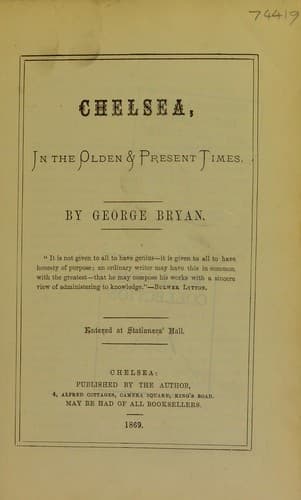
Chelsea, in the Olden & Present Times — John Shaqi
Chelsea, in the Olden & Present TimesBryan, George
History
Chelsea, in the Olden & Present Times
Bryan, George
Chelsea (London, England) -- History
On the banks of the river, in front of Ashburnham House, was a piece of
land, called the Lots. The Lammas rights of the parishioners, with
respect to this land, are now extinct. Those who wish to know the
particulars, will find them fully recorded in the Annual Vestry Reports,
which may be obtained at the Vestry Hall, and which will render many
parochial details in this work quite unnecessary.
* * * * *
On the south side of the King’s Road, and near to the boundary line which
divides the parishes of Chelsea and Fulham, is Dudmarton House, which was
for a considerable period the residence of Samuel Gower Poole, Esq., who
erected a chapel on the premises, where he occasionally preached, and
amongst others the Rev. Dr. Jay, of Bath, the Rev. John and Charles
Hyatt, the Rev. Dr. Collyer, &c. The Rev. Dr. Raffles, it is stated,
preached his first sermon there when he was quite a youth. Mr. Poole
also established a school for the education of poor boys, many of whom
were clothed through his exertions.
Stanley House, St. Mark’s College.
Near to what is now the Chelsea Railway Station, on the north of the
King’s Road, is Stanley House. In the reign of Queen Elizabeth this was
part of the estate of Sir Arthur Gorges, who was knighted in 1597, and
died in 1625, and who built a house on this site for his own residence.
Rowland White, writing to Sir Robert Sidney, Nov. 15, 1599, says, “As the
Queen passed by the faire new building, Sir Arthur Gorges presented her
with a faire jewell.” The family of Gorges at this period possessed very
considerable property in Chelsea, which they afterwards gradually
disposed of to the Cheyne family and others.
* * * * *
Sir Arthur Gorges was the intimate friend of Spenser, who lamented the
death of the first Lady Gorges, daughter of Viscount Bindon, and who died
in 1590, in a beautiful elegy, entitled Daphnaida; he has recorded
likewise the conjugal affection and the talents of her husband, under the
name of Alcyon, in the following elegant lines:—
“And there is sad Alcyon, bent to mourne
Though fit to frame an everlasting dittie;
Whose gentle spright for Daphne’s death doth tourne
Sweet lays of love to endlesse plaints of pittie.
Ah! pensive boy, pursue that brave conceipt
In thy sweet eglantine merriflure;
Lift up thy notes unto their wonted height,
That may my muse and mates to mirth allure.”
Public-domain text, read in full here on John Shaqi.
Reviews
Reviews
No reviews yet
Be the first to share your thoughts on this work.
Join the Discussion
Join the discussion
Sign in to leave a comment or review.
Sign InorCreate an account