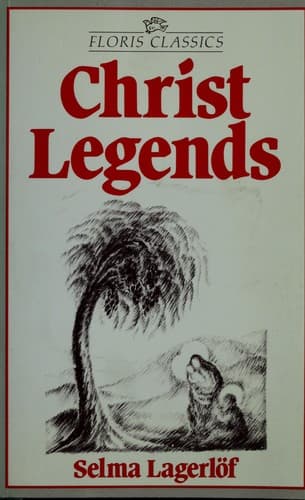
Jesus Christ -- Fiction; Jesus Christ -- Juvenile fiction; Short stories
After this, the vine-dresser and his wife never again spoke to the old
woman about the Emperor. Between themselves they marveled that she, at
her great age, had had the strength to renounce all the wealth and power
to which she had become accustomed. “I wonder if she will not soon go
back to Tiberius?” they asked themselves. “It is certain that she still
loves him. It is in the hope that it will awaken him to reason and
enable him to repent of his low conduct, that she has left him.”
“A man as old as the Emperor will never begin a new life,” said the
laborer. “How are you going to rid him of his great contempt for
mankind? Who could go to him and teach him to love his fellow man? Until
this happens, he can not be cured of suspicion and cruelty.”
“You know that there is one who could actually do it,” said the wife. “I
often think of how it would turn out, if the two should meet. But God’s
ways are not our ways.”
The old woman did not seem to miss her former life at all. After a time
the young wife gave birth to a child. The old woman had the care of it;
she seemed so content in consequence that one could have thought she had
forgotten all her sorrows.
Once every half-year she used to wrap her long, gray mantle around her,
and wander down to Rome. There she did not seek a soul, but went
straight to the Forum. Here she stopped outside a little temple, which
was erected on one side of the superbly decorated square.
All there was of this temple was an uncommonly large altar, which stood
in a marble-paved court under the open sky. On the top of the altar,
Fortuna, the goddess of happiness, was enthroned, and at its foot was a
statue of Tiberius. Encircling the court were buildings for the priests,
storerooms for fuel, and stalls for the beasts of sacrifice.
Old Faustina’s journeys never extended beyond this temple, where those
who would pray for the welfare of Tiberius were wont to come. When she
cast a glance in there and saw that both the goddess’ and the Emperor’s
statue were wreathed in flowers; that the sacrificial fire burned; that
throngs of reverent worshipers were assembled before the altar, and
heard the priests’ low chants sounding thereabouts, she turned around
and went back to the mountains.
In this way she learned, without having to question a human being, that
Tiberius was still among the living, and that all was well with him.
The third time she undertook this journey, she met with a surprise. When
she reached the little temple, she found it empty and deserted. No fire
burned before the statue, and not a worshiper was seen. A couple of
dried garlands still hung on one side of the altar, but this was all
that testified to its former glory. The priests were gone, and the
Emperor’s statue, which stood there unguarded, was damaged and
mud-bespattered.
The old woman turned to the first passer-by. “What does this mean?” she
asked. “Is Tiberius dead? Have we another Emperor?”
Public-domain text, read in full here on John Shaqi.
Reviews
Reviews
No reviews yet
Be the first to share your thoughts on this work.
Join the Discussion
Join the discussion
Sign in to leave a comment or review.
Sign InorCreate an account