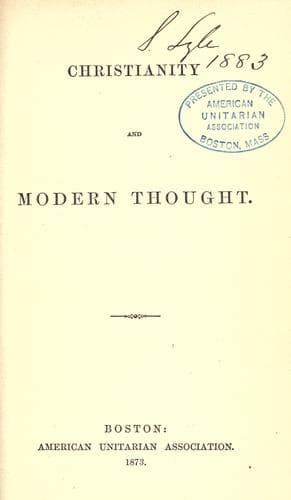
Christianity and Modern ThoughtPeabody, Andrew P. (Andrew Preston)
Religion
Christianity and Modern Thought
Peabody, Andrew P. (Andrew Preston)
Unitarianism
dead, the host is taken away from the altar, and it is carried into the
tomb, carried into some lower chapel, from which it comes back to the
great altar on Easter morning, on the day of the resurrection. That
solemn play is going on in all Roman Catholic countries at the present
time, and that is a "Mystery." Such is also the "Mystery" that was
played in Germany, at Oberammergau (Bavaria), during the last year, and
is played there every ten years. It is a devout, religious, serious,
dramatic representation of our Lord's suffering, death, and
resurrection. The mass in itself was in the beginning a Mystery; it is
often called so; it is often called in old Roman Catholic books and
often in modern ones the "Mystery of the Mass." It was a representation
of the death and sacrifice of Jesus; but the Roman Catholic spirit
coming in declared that this Mystery was not, like others, a mere
representation, a sacred play, but a reality; and according to the
doctrine proclaimed by the Council of Trent, three hundred years ago,
the sacrifice of the mass is much more than a representation of Christ's
death, of Christ's sacrifice, for he is sacrificed anew, he suffers
death really anew. And it has been declared, because some Protestant
opponents were astonished at it, that every time any priest says
mass,--and every priest must say mass at least once every day,--every
time a priest says mass, Christ suffers again, and dies again,
sacrificed by the priest for the redemption of human kind. This is the
doctrine of the mass, and this gives it a very tragic, grand, and solemn
effect in the eyes of those who believe in it. Yet this again is nothing
but Roman literalism, the Roman way of taking every thing literally.
Is all this real Christianity? At all events I have said enough, I hope,
to give you an idea of the way in which the religion of Jesus of
Nazareth, as he was called, preached by him on the hills of Galilee,--a
religion that was quite spirit, and quite truth; a religion that had at
that time no bleeding, no consecrated man, but that was alive by the
Spirit of God in the conscience and in the hearts of men,--how that
religion, purely spiritual as it was, became all the pomp, all the
exterior complications, all the dramatic intricacies of the Church of
Rome.
And here I stop to ask again, Can all this suit the urgent necessities
of our times? Is that the truth after which our souls hunger and thirst?
Public-domain text, read in full here on John Shaqi.
Reviews
Reviews
No reviews yet
Be the first to share your thoughts on this work.
Elsewhere in the archive
Join the Discussion
Join the discussion
Sign in to leave a comment or review.
Sign InorCreate an account