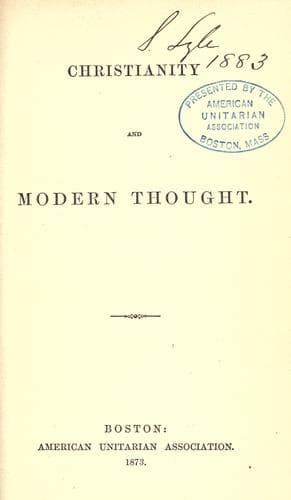
Christianity and Modern ThoughtPeabody, Andrew P. (Andrew Preston)
Religion
Christianity and Modern Thought
Peabody, Andrew P. (Andrew Preston)
Unitarianism
As the great writer Father Perrone wrote, "That dogma has been
developing itself in the church a long time." When I saw the Church of
Rome speaking of a dogma "developing itself," I thought, This is the
beginning of the end. If they understand that dogmas develop themselves,
that they have not fallen like aerolites from the heavens, it seems to
me that that is the end of infallibility. Some people think it was the
beginning of infallibility, that it was the Pope for the first time
declaring a dogma for all men without consulting officially or legally
any one, and that when he had done this he had augmented his power. I
must remark here, that when a pope is very weak, the general rule is, he
does something extremely strong. When he is extremely weak, politically,
materially, he generally makes some great demonstration of spiritual
power. When Pope Gregorius VII. kept Henry in his shirt a whole night at
the door of the castle of Canossa without opening the door to him,
saying, "You are a sinner, do penance,"--when he did that, the Pope had
been expelled from Rome, he had lost Rome, therefore he must prove his
immense spiritual power, because his temporal power was lost. And when
the present Pope has done acts of authority greater than any other pope,
it has not been because he was strong, but because he was weak; to
remain on his throne he wanted to have the bayonets of Louis Bonaparte
to keep him in power. His own subjects would very soon have shown him a
second time the way to the frontier, if they had not been prevented by
the bayonets of that man. Thus the Pope did more towards asserting and
confirming his own power than any of his two hundred and fifty odd
predecessors. When afterwards he took a new step, it was in continuance
of this. He called a council when three hundred years had elapsed since
an [oe]cumenical council had been called. I know old Roman Catholic
families who had been waiting for centuries for the moment when an
[oe]cumenical council should assemble, to denounce before that council
the encroachments of the Pope, and to ask that the popedom be kept
within bounds for the future. Pio IX. had an [oe]cumenical council
called, and held it in his own house, in the Vatican. And there, in one
end of one of the transepts of the immense church of Saint Peter, the
Pope had himself declared infallible by the council. Thus all the other
councils which had been the hope of such persons in the church as could
not accept every word of the Pope, all those councils have been
sacrificed, have abdicated, in the last of them, at the foot of the
Pope. Now, the Roman Catholic Church has become very logically, what it
ought to become, the same thing in the spiritual world that the Roman
Empire became in the temporal world. The Roman Emperor was every thing;
there had been priests and magistrates who had great powers; then the
emperor made himself dictator, consul, tribune of the people; made
Public-domain text, read in full here on John Shaqi.
Reviews
Reviews
No reviews yet
Be the first to share your thoughts on this work.
Elsewhere in the archive
Join the Discussion
Join the discussion
Sign in to leave a comment or review.
Sign InorCreate an account