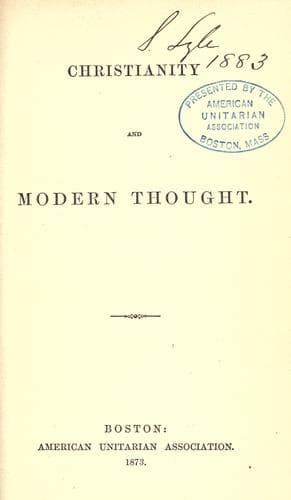
Christianity and Modern ThoughtPeabody, Andrew P. (Andrew Preston)
Religion
Christianity and Modern Thought
Peabody, Andrew P. (Andrew Preston)
Unitarianism
It is the object of this course of lectures, in part at least as I
understand it, to discuss this subject--to discuss, _i.e._ the
principles and grounds, on which right reason and rational Christianity
propose to build up a good and exalted character. Now with regard to
what Christianity teaches, has it never occurred to you, or has it never
seemed to you, in reading the Gospels, that they appeal to
self-interest, to the desire to be saved, in a way that is at variance
with the loftiest motives? But it is appealed to, and therefore is, in
some sense, sanctioned. And yet, as if this self-interest were something
wrong, the prevalence of it in the world, the world's selfishness in
other words, is represented by many preachers, as if it were the sum of
all wickedness, the proof indeed, of total depravity. Here then, it
seems to me, whether we look at Christianity or at the teachings of the
pulpit, there is urgent need of discrimination. And there is another
aspect of the same subject, which seems to require attention; and that
is what is called, individualism--the mentally living, if not for, yet
in and out of ourselves; claiming to find all the springs and forces of
faith and culture within ourselves, to the exclusion of the proper
influence of society, of Christianity, of the whole great realm of the
past, by which we have been trained and formed; individualism, which
says, "I belong to myself, and to nobody else, and do not choose to be
brought or organized into any system of faith or action with anybody
else." This, indeed, is an extreme to which, perhaps, but few minds go;
but there is a tendency of this kind, which needs to be looked into.
Now there is a way of thinking, in matters of practical expediency, to
which I confess that I am committed by my life-long reflections; and
which has always prevented me from going to the extreme with any party,
whether in reforms, in politics, in religious systems, or in any thing
else; and that is, to look to the mean in things; to look upon human
nature and human culture, as held in the balance between opposing
principles. With this view, I shall first undertake to show that the
principle of self-regard, or of individualism, is right and lawful--is
indeed, an essential principle of culture.
There is a remarkable passage in the old "Theologia Germanica," which
hits, I think, the very point in this matter of self-regard. Speaking of
its highest man, it says, "All thought of self, all self-seeking,
self-will, and what cometh thereof, must be utterly lost, surrendered
and given over to God, _except in so far as they are necessary to make
up a person_." This personality, this stand-point, we must hold to, go
where we will.
Public-domain text, read in full here on John Shaqi.
Reviews
Reviews
No reviews yet
Be the first to share your thoughts on this work.
Elsewhere in the archive
Join the Discussion
Join the discussion
Sign in to leave a comment or review.
Sign InorCreate an account