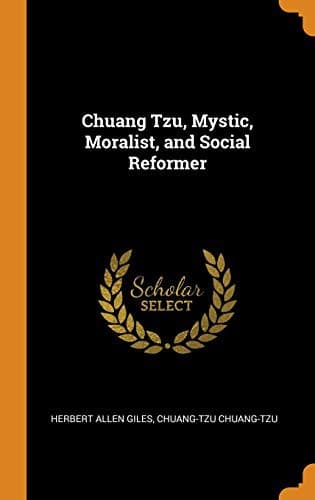
Chuang Tzu: Mystic, Moralist, and Social ReformerZhuangzi
Religion
Chuang Tzu: Mystic, Moralist, and Social Reformer
Zhuangzi
Ethics -- China; Philosophy, Chinese
"From the point of view of difference," replied Confucius, "we
distinguish between the liver and the gall, between the Ch'u State and
the Yüeh State. From the point of view of sameness, all things are
ONE. Such is the position of Wang T'ai. He does not trouble about what
reaches him through the senses of hearing and sight, but directs his
whole mind towards the very climax of virtue. He beholds all things
as though ONE, without observing their discrepancies. And thus the
discrepancy of his toes is to him as would be the loss of so much mud."
"He devotes himself in fact to himself," said Ch'ang Chi, "and uses his
wisdom to perfect his mind, until it becomes perfect. But how then is
it that people make so much of him?"
His virtue being wholly, as it were, of a selfish order.
"A man," replied Confucius, "does not seek to see himself in running
water, but in still water. For only what is itself still can instil
stillness into others.
"The grace of earth has reached only to pines and cedars;--winter and
summer alike they are green. The grace of God has reached to Yao and to
Shun alone;--the first and foremost of all creation. Happily they were
able to regulate their own lives and thus regulate the lives of all
mankind.
"By nourishment of physical courage, the sense of fear may be so
eliminated that a man will, single-handed, brave a whole army. And if
such a result can be achieved in search of fame, how much more by one
who extends his sway over heaven and earth and influences all things;
and who, lodging within the confines of a body with its channels of
sight and sound, brings his knowledge to know that all things are ONE,
and that his soul endures for ever! Besides, he awaits his appointed
hour, and men flock to him of their own accord. He makes no effort to
attract them."
That men thus gather around him is the outward sign or evidence of his
inward virtue complete.
Shên T'u Chia had had his toes cut off. Subsequently, he studied under
Poh Hun Wu Jen at the same time as Tzŭ Ch'an of the Chêng State. The
latter said to him, "When I leave first, do you remain awhile. When you
leave first, I will remain behind."
Tzŭ Ch'an was a model minister of the sixth century B.C. Under his
guidance the people of the Chêng State became so virtuous that doors
were not locked at night, nor would any one pick up lost articles left
lying in the road. He was hardly likely to be ashamed of walking out
with a mutilated criminal.
Next day, when they were again together in the lecture-room, Tzŭ Ch'an
said, "When I leave first, do you remain awhile. When you leave first,
I will remain. I am now about to go. Will you remain or not? I notice
you show no respect to a Minister of State. Perhaps you think yourself
my equal?"
Public-domain text, read in full here on John Shaqi.
Reviews
Reviews
No reviews yet
Be the first to share your thoughts on this work.
Join the Discussion
Join the discussion
Sign in to leave a comment or review.
Sign InorCreate an account