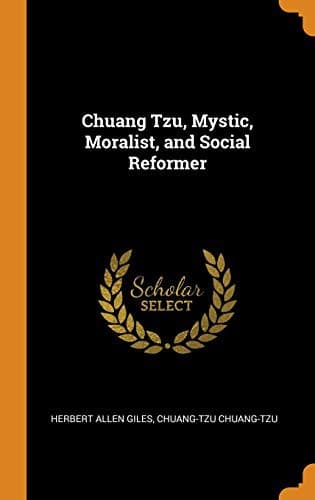
Chuang Tzu: Mystic, Moralist, and Social ReformerZhuangzi
Religion
Chuang Tzu: Mystic, Moralist, and Social Reformer
Zhuangzi
Ethics -- China; Philosophy, Chinese
"Why do you not meet him with the continuity of life and death, the
identity of _can_ and _can not_," answered Lao Tzŭ, "and so release him
from these fetters?"
"He has been thus punished by God," replied No-toes. "It would be
impossible to release him."
A sneer at Confucius. No-toes himself had only been punished by man.
Duke Ai of the Lu State said to Confucius, "In the Wei State there is a
leper, named Ai T'ai T'o. The men who live with him like him and make
no effort to get rid of him. Of the women who have seen him, many have
said to their parents, Rather than be another man's wife, I would be
his concubine.
"He never preaches at people, but puts himself into sympathy with
them. He wields no power by which he may protect men's bodies. He has
at his disposal no appointments by which to gratify their hearts. He
is loathsome to a degree. He sympathises, but does not instruct. His
knowledge is limited to his own State. Yet males and females alike all
congregate around him.
"So thinking that he must be different from ordinary men, I sent for
him, and saw that he was indeed loathsome to a degree. Yet we had not
been many months together ere my attention was fixed upon his conduct.
A year had not elapsed ere I trusted him thoroughly; and as my State
wanted a Prime Minister, I offered the post to him. He accepted it
sullenly, as if he would much rather have declined. Perhaps he didn't
think me good enough for him! At any rate, he took it; but in a very
short time he left me and went away. I grieved for him as for a lost
friend, and as though there were none left with whom I could rejoice.
What manner of man is this?
"When I was on a mission to the Ch'u State," replied Confucius, "I saw
a litter of young pigs sucking their dead mother. After a while they
looked at her, and then they all left the body and went off. For their
mother did not look at them any more, nor did she any more seem to be
of their kind. What they loved was their mother; not the body which
contained her, but that which made the body what it was.
"When a man is killed in battle, his arms are not buried with him.
He has no further use for weapons.
A man whose toes have been cut off does not value a present of boots.
In each case the function of such things is gone.
"The concubines of the Son of Heaven do not cut their nails or pierce
their ears.
For fear of injuring their persons.
He who has a marriageable daughter keeps her away from menial work. To
preserve her beauty is quite enough occupation for her. How much more
so for a man of perfect virtue?
Who should trouble himself only about the internal.
"Now Ai T'ai T'o says nothing, and is trusted. He does nothing, and is
sought after. He causes a man to offer him the government of his own
State, and the only fear is lest he should decline. Truly his talents
are perfect and his virtue without outward form!"
"What do you mean by his talents being perfect?" asked the Duke.
Public-domain text, read in full here on John Shaqi.
Reviews
Reviews
No reviews yet
Be the first to share your thoughts on this work.
Join the Discussion
Join the discussion
Sign in to leave a comment or review.
Sign InorCreate an account