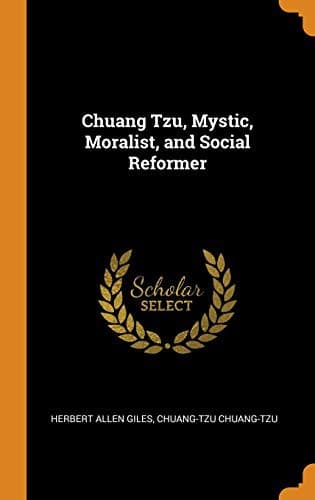
Chuang Tzu: Mystic, Moralist, and Social ReformerZhuangzi
Religion
Chuang Tzu: Mystic, Moralist, and Social Reformer
Zhuangzi
Ethics -- China; Philosophy, Chinese
TAO gives me this form, this toil in manhood, this repose in old age,
this rest in death. And surely that which is such a kind arbiter of my
life is the best arbiter of my death.
A boat may be hidden in a creek, or in a bog, safe enough.
The text has "or a mountain in a bog," which taken with the context
seems to me to be nonsense. Yet all the commentators labour to
explain away the difficulty, instead of making the obvious change of
"mountain" into "boat," to which change the forms of the two Chinese
characters readily lend themselves. In over two thousand years of
literary activity, it seems but rarely to have occurred to the Chinese
that a _textus receptus_ could contain a copyist's slip.
But at midnight a strong man may come and carry away the boat on his
back. The dull of vision do not perceive that however you conceal
things, small ones in larger ones, there will always be a chance of
losing them.
The boat is figurative of our mortal coil which cannot be hidden from
decay.
But if you conceal the whole universe in the whole universe, there will
be no place left wherein it may be lost. The laws of matter make this
to be so.
To have attained to the human form must be always a source of joy. And
then, to undergo countless transitions, with only the infinite to look
forward to,--what incomparable bliss is that! Therefore it is that the
truly wise rejoice in that which can never be lost, but endures alway.
The soul which as TAO, is commensurate only with time and space.
For if we can accept early death, old age, a beginning, and an end,
As inseparable from Destiny,--already a step in the right direction.
why not that which informs all creation and is of all phenomena the
Ultimate Cause?
The long chain of proximate causes reaches finality in TAO. Here we
have the complete answer to such queries as that propounded to the
Umbra by the Penumbra at the close of ch. ii.
TAO has its laws, and its evidences. It is devoid both of action and of
form. It may be transmitted, but cannot be received.
So that the receiver can say he has it.
It may be obtained, but cannot be seen. Before heaven and earth were,
TAO was. It has existed without change from all time. Spiritual beings
drew their spirituality therefrom, while the universe became what we
can see it now. To TAO, the zenith is not high, nor the nadir low; no
point in time is long ago, nor by lapse of ages has it grown old.
To the infinite all terms and conditions are relative.
Hsi Wei obtained TAO, and so set the universe in order.
A legendary ruler of remote antiquity. In what sense he set the
universe in order has not been authentically handed down.
Fu Hsi obtained it, and was able to establish eternal principles.
The first in the received list of Chinese sovereigns (B.C. 2852). This
monarch is said to have invented the art of writing and to have taught
his people to cook.
Public-domain text, read in full here on John Shaqi.
Reviews
Reviews
No reviews yet
Be the first to share your thoughts on this work.
Elsewhere in the archive
Join the Discussion
Join the discussion
Sign in to leave a comment or review.
Sign InorCreate an account