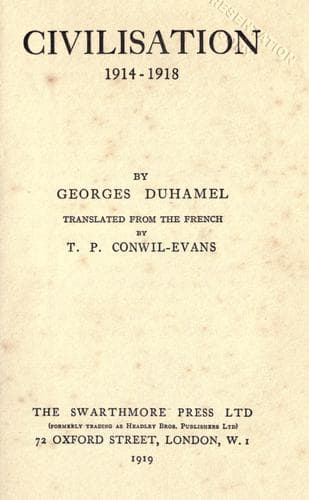
Short stories, French -- Translations into English; World War, 1914-1918 -- Fiction
The cold and the wind had given rise to an epidemic of fires on the
front. The little stoves had been stuffed to their fullest capacity,
and they crackled and smoked convulsively, and the corners of sheds
sometimes caught their fever. A flame stuck its nose outside: the wind
snapped at it, twisted, stretched it, swelled it like a sail, and most
often it cost five or six thousand francs in wood, paper, canvas, and
other materials. When the Germans saw it happening within gunshot
distance, they despatched a few explosives with the charitable object
of helping on its sinister designs. It’s what you must expect, you
know. You either make or you don’t make war. And the miserable world
has made it--there’s no shadow of doubt about that.
We had lost in this way many huts, which were happily cut off from the
others, and it had been a useful warning to us when, one night, about
one o’clock, a fire--a terrible fire--broke out in Hut 521, which could
be seen on the plain three or four miles away from us.
We had just put on our boots and had gone out to watch it. What a sight
it was! The huge furnace with its tongues of flame, the bluish country
benumbed with frost, the wind which seemed to ripple like water in the
moonlight, and the reflections of the fire on the Siberian landscape,
honeycombed with the old trenches of 1915.
We were horrified at the thought of what was happening there; but we
did not dare to leave our post.
And we did right; for towards 3 A.M. a long line of motors came hooting
before the door--some of the wounded rescued from the fire were being
brought to us.
We got them out of the cars. How patient they were, poor things! Two
with fractured skulls, one with an amputated leg, and another with
a broken leg, and several less seriously wounded. They had lost in
the fire all the possessions which, as soldiers, they were allowed to
have--the linen bag you see hanging on the bed, containing a knife, a
box of matches, three or four old letters, and a small lead pencil. I
repeat, they did behave well; but they were pitiful to look at. They
really looked like people who for one awful moment had lain helpless
in their beds while the flames surrounded them, and who were conscious
of only one agonising thought: “If help doesn’t come at once, in five
minutes it will be too late.”
We put them into bed, and got them warm again: they needed it. I well
remember seeing icicles glistening on the bandages of the man with the
broken leg. It was a sorry business. The whole night long we looked
after them; and only in the morning were we able to chat round the
coffee-pot. The wounded were dozing. The hut was almost warm. We had
made them wear cotton caps and woollen vests, and drink a cupful of
boiling milk. They were in a half-dozing, half-waking state and seemed
to be thinking: “Lord! what a narrow shave! And it’s the second one
too. We had better look out for the third.”
It was then, old fellow, that M. Perrier-Langlade arrived on the scene.
Public-domain text, read in full here on John Shaqi.
Reviews
Reviews
No reviews yet
Be the first to share your thoughts on this work.
Elsewhere in the archive
Join the Discussion
Join the discussion
Sign in to leave a comment or review.
Sign InorCreate an account