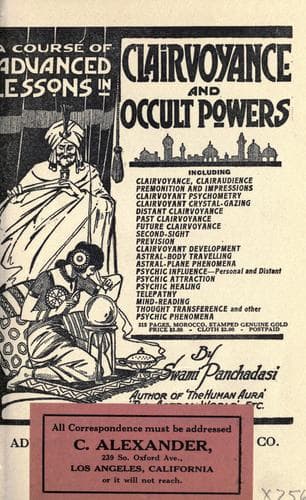
Clairvoyance and Occult PowersAtkinson, William Walker
Religion
Clairvoyance and Occult Powers
Atkinson, William Walker
Clairvoyance
The Willing Game, quite popular in some circles, is played by one person
(usually blind-folded) being brought into the room in which a number of
persons have previously agreed upon some object to be found by him, they
concentrating their thought firmly upon the object. The audience should be
taught to not only to think but also to actively "will" the progress of
the recipient from the start to the finish of the hunt. They should "will"
him along each step of his journey, and then "will" his hand to the object
itself wherever it be hidden.
An adept in the receiving end of the Willing Game will be able to perform
all the experiments that I have just pointed out to you in the contact
mind-reading class. In the Willing Game, you must remember that there is
no taking hold of hands or any other form of physical contact between
projector and recipient. The transmission of the mental currents must be
direct, from brain to brain. Otherwise, the two classes of experiments are
almost identical. There is the same "willing" toward the object on the
part of the projectors, and the same passive obedience of the recipient.
All the difference is that the current now passes over the ether of
space, as in the case of the wireless message, instead of over the wires
of the nervous system of the two persons.
The next step is that of "guessing" the name of things thought of by the
party. I can give you no better directions than those followed by the
investigators in the Creery children, as related in a preceding chapter of
this book. When you become sufficiently proficient in this class of
mind-reading, you should be able to reproduce every experiment there
mentioned, with at least a fair degree of success. It is all a matter of
patience, perseverance and practice.
After you have become very proficient in this class of experiments, you
may begin to try experiments at "long distance," that is where the
projector is out of your physical presence. It makes no difference whether
the distance be merely that between two adjoining rooms, or else of miles
of space. At first, however, nearness adds confidence in the majority of
cases. Confidence once gained, the distance may be lengthened
indefinitely, without impairing the success of the experiments. The long
distance experiments may consist either of the receiving of single words,
names, etc., or else distinct, clear messages or ideas. Some find it no
more difficult to reproduce simile geometrical designs, such as circles,
squares, triangles, etc., than to reproduce words or ideas.
In long distance experiments, it is well for the projector to write down
the word or thought he wishes to transmit, and for the recipient to write
down the impressions he receives. These memoranda will serve as a record
of progress, and will, moreover, give a scientific value to the
experiments.
Public-domain text, read in full here on John Shaqi.
Reviews
Reviews
No reviews yet
Be the first to share your thoughts on this work.
Join the Discussion
Join the discussion
Sign in to leave a comment or review.
Sign InorCreate an account