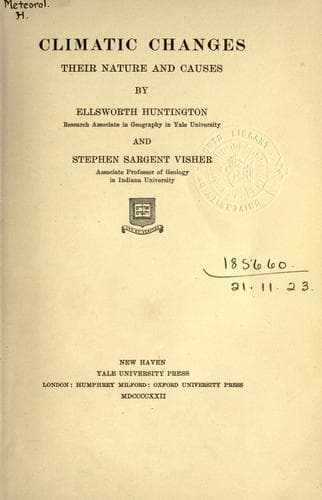
Climatic Changes: Their Nature and CausesHuntington, Ellsworth
Science
Climatic Changes: Their Nature and Causes
Huntington, Ellsworth
Climatic changes; Climatology; Paleoclimatology
These stations are distributed over an area nearly 500 miles east and
west. Manifestly a traveler who spent the year 1885 in that region would
have had much more difficulty in finding water and forage than one who
traveled in the same places in 1905. During 1885 the rainfall was 42 per
cent less than the average, and during 1905 it was 134 per cent more
than the average. Let us suppose, for the sake of argument, that the
average rainfall of southeastern Persia is six inches today and was ten
inches in the days of Alexander. If the rainfall from year to year
varied as much in the past in Persia as it does now in New Mexico and
Arizona, the rainfall during an ancient dry year, corresponding in
character to 1885, would have been about 5.75 inches. On the other hand,
if we suppose that the rainfall then averaged less than at present,--let
us say four inches,--a wet year corresponding to 1905 in the American
deserts might have had a rainfall of about ten inches. This being the
case, it is clear that our estimate of what Alexander's march shows as
to climate must depend largely on whether 325 B. C. was a wet year or a
dry year. Inasmuch as we know nothing about this, we must fall back on
the fact that a large army accomplished a journey in a place where today
even a small caravan usually finds great difficulty in procuring forage
and water. Moreover, elephants were taken 180 miles across what is now
an almost waterless desert, and yet the old historians make no comment
on such a feat which today would be practically impossible. These things
seem more in harmony with a change of climate than with uniformity.
Nevertheless, it is not safe to place much reliance on them except when
they are taken in conjunction with other evidence, such as the numerous
ruins, which show that Makran was once far more densely populated than
now seems possible. Taken by itself, such incidents as Alexander's march
cannot safely be used either as an argument for or against changes of
climate.
The third and strongest objection to any hypothesis of climatic changes
during historic times is based on vegetation. The whole question is
admirably set forth by J. W. Gregory,[28] who gives not only his own
results, but those of the ablest scholars who have preceded him. His
conclusions are important because they represent one of the few cases
where a definite statistical attempt has been made to prove the exact
condition of the climate of the past. After stating various less
important reasons for believing that the climate of Palestine has not
changed, he discusses vegetation. The following quotation indicates his
line of thought. A sentence near the beginning is italicized in order to
call attention to the importance which Gregory and others lay on this
particular kind of evidence:
Public-domain text, read in full here on John Shaqi.
Reviews
Reviews
No reviews yet
Be the first to share your thoughts on this work.
Join the Discussion
Join the discussion
Sign in to leave a comment or review.
Sign InorCreate an account