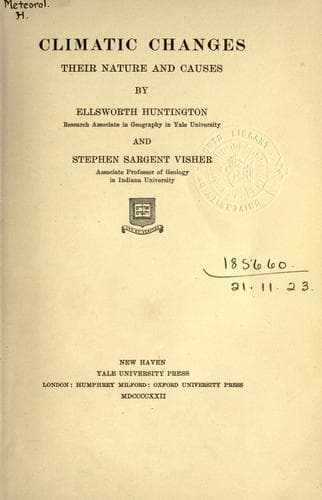
Climatic Changes: Their Nature and CausesHuntington, Ellsworth
Science
Climatic Changes: Their Nature and Causes
Huntington, Ellsworth
Climatic changes; Climatology; Paleoclimatology
[Footnote 16: Much of this chapter is taken from The Solar Hypothesis of
Climatic Changes; Bull. Geol. Soc. Am., Vol. 25, 1914.]
[Footnote 17: Ellsworth Huntington: Explorations in Turkestan, 1905; The
Pulse of Asia, 1907; Palestine and Its Transformation, 1911; The
Climatic Factor, 1915; World Power and Evolution, 1919.]
[Footnote 18: J. Hann: Klimatologie, Vol. 1, 1908, p. 352.]
[Footnote 19: H. C. Butler: Desert Syria, the Land of a Lost
Civilization; Geographical Review, Feb., 1920, pp. 77-108.]
[Footnote 20: This is due to the fact that where these forests occur, in
Gilead for example, the mountains to the west break down, so that the
west winds with water from the Mediterranean are able to reach the inner
range without having lost all their water. It is one of the misfortunes
of Syria that its mountains generally rise so close to the sea that they
shut off rainfall from the interior and cause the rain to fall on slopes
too steep for easy cultivation.]
[Footnote 21: H. Leiter: Die Frage der Klimaanderung waherend
geschichtlicher Zeit in Nordafrika. Abhandl. K. K. Geographischen
Gesellschaft, Wien, 1909, p. 143.]
[Footnote 22: A most careful and convincing study of this problem is
embodied in an article by J. W. Smith: The Effects of Weather upon the
Yield of Corn; Monthly Weather Review, Vol. 42, 1914, pp. 78-92. On the
basis of the yield of corn in Ohio for 60 years and in other states for
shorter periods, he shows that the rainfall of July has almost as much
influence on the crop as has the rainfall of all other months combined.
See his Agricultural Meteorology, New York, 1920.]
[Footnote 23: See chapter by A. E. Douglass in The Climatic Factor; and
his book on Climatic Cycles and Tree-Growth; Carnegie Inst., 1919. Also
article by M. N. Stewart: The Relation of Precipitation to Tree Growth,
in the Monthly Weather Review, Vol. 41, 1913.]
[Footnote 24: The dotted line is taken from Palestine and Its
Transformation, pp. 327 and 403.]
[Footnote 25: M. A. Stein: Ruins of Desert Cathay, London, 1912.]
[Footnote 26: In the preparation and interpretation of this table the
help of Mr. G. B. Cressey is gratefully acknowledged.]
[Footnote 27: For the tree data used in these comparisons, see The
Climatic Factor P. 328, and A. E. Douglass: Climatic Cycles and Tree
Growth, p. 123.]
[Footnote A: One year interpolated.]
[Footnote 28: J. W. Gregory: Is the Earth Drying Up? Geog. Jour., Vol.
43, 1914, pp. 148-172 and 293-318.]
[Footnote 29: Geog. Jour., Vol. 43, pp. 159-161.]
[Footnote 30: See A. J. Henry: Secular Variation of Precipitation in the
United States; Bull. Am. Geog. Soc., Vol. 46, 1914, pp. 192-201.]
CHAPTER VI
THE CLIMATIC STRESS OF THE FOURTEENTH CENTURY
Public-domain text, read in full here on John Shaqi.
Reviews
Reviews
No reviews yet
Be the first to share your thoughts on this work.
Elsewhere in the archive
Join the Discussion
Join the discussion
Sign in to leave a comment or review.
Sign InorCreate an account